
- Quant 30 – Up over 24% since June
- Quant Weekly – Up over 40% since June
- Legacy – Up over 250% since April 2023
- Education – Main points of the book “1929: Inside the Greatest Crash in Wall Street History–and How It Shattered a Nation” by Alan Ross Sorkin
Major indexes climbed for the week — the S&P 500 rose about 1.6%, the Dow Jones Industrial Average gained roughly 2.3%, and the Nasdaq Composite increased nearly 1.9% by Friday’s close. The small-cap Russell 2000 outperformed, up around 4.6% for the week.
Record highs were reached — both the S&P 500 and the Dow set new closing records during the week, with the S&P topping its prior all-time high and the Dow continuing its strong start to 2026.
Positive jobs data helped sentiment — weaker-than-expected job additions combined with a lower unemployment rate boosted optimism that the Federal Reserve might hold rates steady, which supported stock gains.
Broad participation in the rally — gains were seen across market caps, with small caps notably outperforming, while technology and other sectors also contributed to the weekly advance.
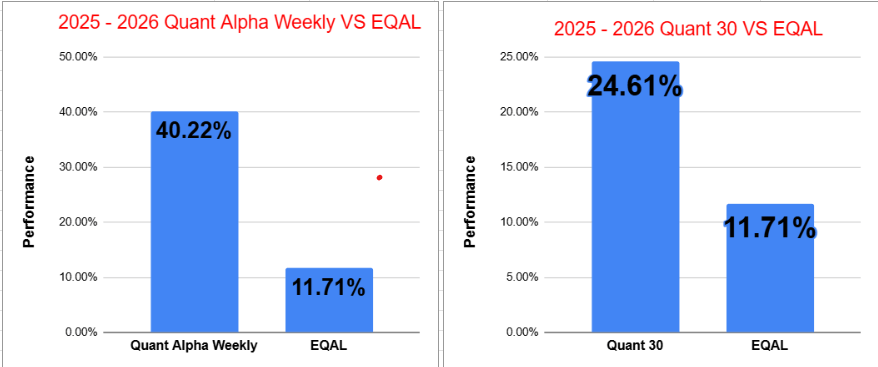
The Quant Alpha Weekly and Quant 30 Portfolios both made all time highs, closing the week up 40% and 24% respectively.

Note: This site now offers both a free and a paid subscription. Paid subscribers receive weekly Portfolio updates as soon as they’re released. Free subscribers still get full content, but Portfolio updates will be posted with at least a two-week delay. Want timely access to the new Adds/Removes? Click here.
Model Portfolio Quant Alpha Weekly
The newly Added stock, if any, is being released to the Paid Subscribers today. Shown below are the updates from two weeks ago. This Portfolio continues to beat its benchmark by a wide margin, 40% to 11%.
No Adds to the Portfolio this week
Add (12/26/25) : None
Outperformers: CLS (Celestica) up over 50%, MU (Micron Technology) up over 100%, COMM (CommScope) up over +130%
Click here for the Quant Alpha Weekly details
Model Portfolio Quant 30
This week’s new update, if any, is being released to the paid subscribers. Shown below is the update made two weeks ago. This Portfolio continues to beat its benchmark by a wide margin, 24% to 11%.
One new Add and one Removal for this update.
Add (12/26/25) : OWLT (Owlet)
Remove (12/26/25) : AXIA (AXIA Energia)
Outperformers: MU (Micron Technology) up over 150%, GFI (Gold Fields) up over 80% and CLS (Celestica) are up over 50%.
Click here for the Quant 30 details
What does Owlet do?
Owlet, Inc. delivers digital parenting and infant health solutions in the U.S. and internationally. The company’s platform gives parents real-time health and sleep data through connected devices, including its Smart Sock and Dream Sock wearable monitors that track heart rate, oxygen levels, activity, and sleep. Owlet also offers BabySat for medically monitored infants, video monitoring through Owlet Cam, bundled monitoring systems, and the Owlet360 subscription for ongoing insights and analytics. Founded in 2012, Owlet is based in Lehi, Utah.
Pros for Owlet
- Strong Revenue Growth: Owlet is posting 24–28% YoY growth, beating and raising guidance. Q2 2025 revenue hit $26.1M (+26% YoY), with full-year outlook lifted to $97–100M.
- FDA Issues Behind It: Regulatory clearance is back in place, revenue is above prior highs, and credibility with customers and partners is restored.
- Higher-Margin Mix: The Owlet 360 subscription is shifting the model toward recurring, higher-margin platform revenue.
- Multiple Growth Catalysts: Expansion via BabySat partnerships, a new DME deal with 1 Natural Way, telehealth pilots, and early-stage international growth.
- Attractive Valuation: Shares trade at a low sales multiple for the growth rate, with EBITDA profitability signaling a turnaround.
Cons for Owlet
- Still Losing Money: Despite EBITDA-positive results, net losses persist as SG&A remains elevated during scaling.
- Macro & Tariff Risk: Tariffs and supply-chain pressures could squeeze margins, especially internationally.
- Regulatory & Execution Risk: Past FDA issues linger as a risk, along with customer concentration and potential dilution as growth investments continue.
Model Portfolio Quant Alpha’s – Legacy
The portfolio now has around 19 stocks in it. It is up over +250% since it began in 2023. Celestica achieves a 11 bagger performance.
Remove (12/26/25): None
Outperformers: AGX (Argan) up over 300%, WGS (GeneDx Holdings) up over 300%, STRL (Sterling Infrastructure) up over 400%, POWL (Powell Industries) up over 500% and CLS (Celestica) is up over 1100%
Click here for the Quant Alpha’s – Legacy details

Performance to 01-09-2026
| Portfolio start date 6/27/25 | |
| Quant Alpha Weekly | 40.22% |
| EQAL (Russell 1000 Equal Weight ETF) | 11.71% |
| Portfolio start date 6/27/25 | |
| Quant 30 | 24.61% |
| EQAL (Russell 1000 Equal Weight ETF) | 11.71% |
| Portfolio start date 4/14/23 | |
| Quant Alpha’s – Legacy | 271.20% |
| EQAL (Russell 1000 Equal Weight ETF) | 35.53% |
Click here for the Live Quant scorecard

The Quant Alpha Weekly Portfolio remains ahead of its benchmark. Up over 40% since it began on June 27, 2025.
The Quant 30 Portfolio managed to close ahead of the benchmark once again. It is up 24% since it began on June 27, 2025.
The Quant Alpha’s – Legacy Portfolio maintained its over 250% return since April 2023, in a classic Position Trading Portfolio implementation.

Highlights of the book “1929” by Sorkin.
- The book examines how the 1929 stock market crash transformed a market correction into the Great Depression.
- Sorkin argues the crash was not inevitable but the result of human decisions, policy errors, and excess speculation.
- The 1920s bull market was fueled by easy credit, margin buying, and public enthusiasm for stocks.
- Ordinary Americans became speculators, often buying stocks with as little as 10% down.
- Financial institutions and brokers aggressively promoted leverage, amplifying risk across the system.
- The Federal Reserve sent mixed signals, tightening too late and without clear communication.
- Early warnings from economists and insiders were largely ignored amid euphoria.
- The initial market break in October 1929 was disorderly but not catastrophic on its own.
- Panic was worsened by poor communication, rumors, and lack of coordinated response.
- Bank failures accelerated as depositors lost confidence, turning a market crash into a financial crisis.
- The gold standard constrained policymakers, limiting their ability to inject liquidity.
- Political leaders underestimated the severity of the downturn and responded too cautiously.
- Confidence collapsed faster than fundamentals, deepening the economic contraction.
- The crash exposed weaknesses in regulation, central banking, and corporate transparency.
- Sorkin concludes that mismanagement after the crash, more than the crash itself, made the Depression “great.”
Direct parallels: 1929 → 2008 → 2020 → today
1929
- Leverage + weak regulation
- Policy delay and mixed signals
- Liquidity collapse → bank failures → economic spiral
2008
- Housing leverage replaced stock leverage
- Faster response, but still behind the curve
- Depression avoided only through massive intervention
2020
- Shock was external, not financial (COVID)
- Immediate, overwhelming policy response
- Confidence preserved → fastest recovery on record
Today
- Leverage has migrated to private credit, derivatives, and duration risk
- Policy risk is asymmetric:
- Tighten too long → accident
- Ease too fast → inflation resurgence
- The system is more liquid, but confidence remains fragile
Bottom-line
- Crashes are inevitable. Depressions are optional.
- Liquidity + confidence determine outcomes, not valuations alone.
- Markets don’t fail catastrophically — policy responses do.
- The biggest risk isn’t the drawdown you see — it’s the second-order effects you don’t.
Website Investment Educational Blog Posts –
All content on this site is for informational purposes only and does not constitute financial advice. Consult relevant financial professionals in your country of residence to get personalized advice before you make any trading or investing decisions. This post was written with the assistance of artificial intelligence. The original ideas and final review are human-generated. Disclaimer
Copyright 2023-2026 SwingTrader.Trading. All Rights Reserved.


You must be logged in to post a comment.