
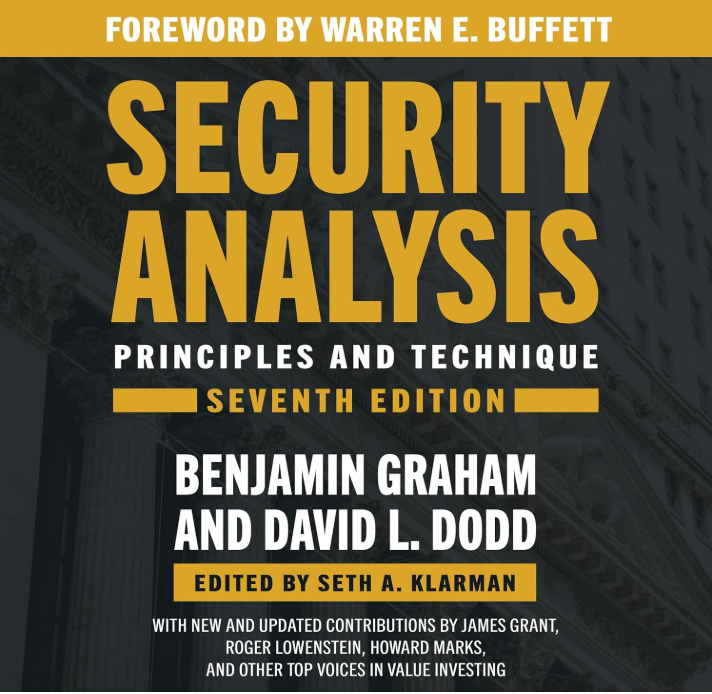
Below are some highlights from the bestselling book by Benjamin Graham and David Dodd. It details how the value investor must constantly be in the process of reinvention, of raising his or her game to navigate the terrain of new eras, novel securities, nascent businesses, emerging industries, shifting standards, and evolving market conditions. The book was originally published in 1934 and the current seventh edition has been updated with thoughts from modern day masters of value investing.
Highlights
Investing is about intrinsic value, not market price
The goal is to estimate what a business is truly worth and buy it below that level.
Markets are often irrational
Prices swing based on emotion, news, and sentiment—not always fundamentals.
Margin of safety is everything
Buying well below intrinsic value protects you from mistakes and bad luck.
Focus on downside first
Avoiding large losses is more important than maximizing gains.
Earnings matter, but quality matters more
Stable, repeatable earnings are far more valuable than volatile spikes.
Balance sheet strength is critical
Strong assets and manageable liabilities provide resilience during downturns.
Assets can provide a floor value
Tangible assets can support a stock’s value even if earnings disappoint.
Not all earnings are equal
Adjust reported numbers for one-time events and accounting tricks.
Diversification reduces risk of error
Even the best analysis can be wrong, so spread your bets.

Speculation and investing are not the same
Investing relies on analysis and value; speculation relies on price movement.
Market fluctuations are opportunities
Price swings allow you to buy cheap or sell expensive.
Buy unpopular or overlooked securities
The best bargains are often found where others aren’t looking.
Avoid overpaying for growth
High expectations are often priced in, leaving little margin for error.
Historical performance matters
Past data provides context but should not be blindly extrapolated.
Management quality matters
Good leadership can enhance value, but numbers still come first.
Debt is a major risk factor
Too much leverage can quickly turn a small problem into a disaster.
Preferred stocks and bonds require different analysis than equities
Income, coverage, and safety take priority over growth.
Fixed income investing is about safety and coverage
Focus on the issuer’s ability to meet obligations consistently.
Cyclical companies must be valued across cycles
Don’t judge them based on peak earnings alone.
Special situations can create opportunity
Events like restructurings or spin-offs often lead to mispricing.
Net-net investing offers deep value
Buying below net current asset value provides extreme downside protection.
Patience is required
Value may take time to be recognized by the market.
Discipline beats intelligence
Following a consistent process matters more than occasional brilliance.
The goal is to avoid big losses
Long-term success comes from preserving capital and compounding steadily.
Bottom Line
Buy value, not hype — focus on what a business is truly worth, not what the market is saying today
Protect downside first — margin of safety and balance sheet strength are your survival tools
Stay patient and disciplined — the edge comes from consistency, not chasing quick wins

Position Trader educational blog posts
Position Trader – blog post user guide
All content on this site is for informational purposes only and does not constitute financial advice. Consult relevant financial professionals in your country of residence to get personalized advice before you make any trading or investing decisions. This post was written with the assistance of artificial intelligence. The original ideas and final review are human-generated. Disclaimer
Copyright 2023-2026 SwingTrader.Trading. All Rights Reserved.
 Position Trader
You must be logged in to post a comment.