
- Foundational Theory
- The Financial Metrics
- Execution & Systematic Rules
- Discipline & Market Psychology
- Results & The Long View
- How has the ‘Magic Formula’ performed 2005 – 2026?
- Bottom Line
- Related Video
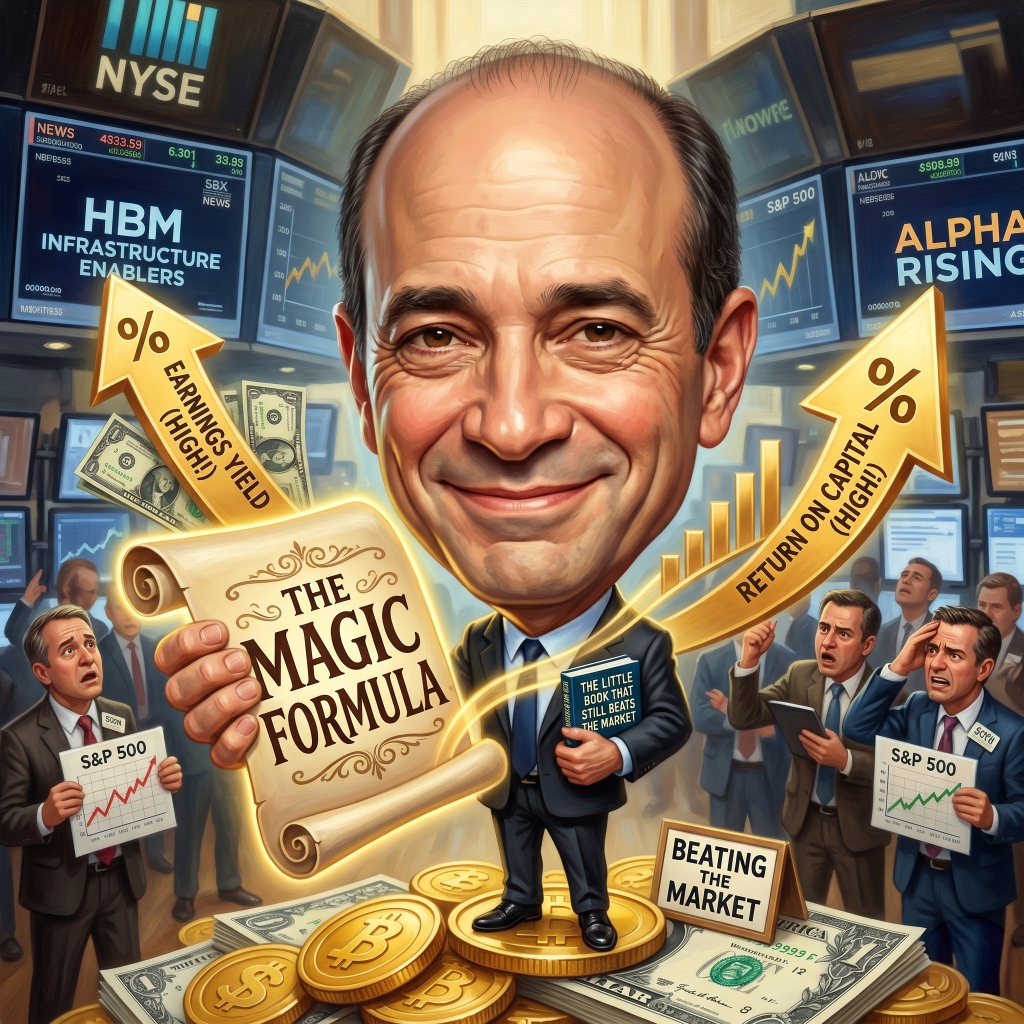
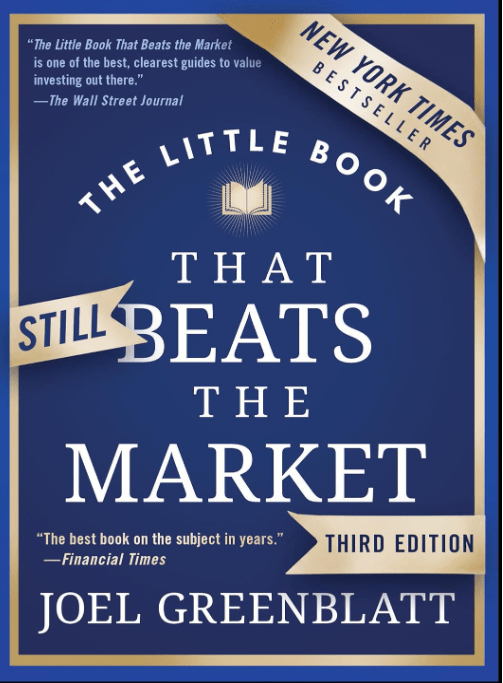
Below are some highlights from the best selling book The Little Book That Still Beats the Market by Joel Greenblatt. . In a straightforward and accessible style, the book explores the basic principles of successful stock market investing and then reveals the author’s time-tested formula that makes buying above average companies at below average prices automatic. Though the formula has been extensively tested and is a breakthrough in the academic and professional world, Greenblatt explains it using 6th grade math, plain language and humor. He shows how to use his method to beat both the market and professional managers by a wide margin. You’ll also learn why success eludes almost all individual and professional investors, and why the formula will continue to work even after everyone “knows” it. The third edition was recently released.
Highlights
I. Foundational Theory
- The Power of the Pedagogy (Jason’s Gum Shops) Before touching the stock market, Greenblatt uses a fictional gum shop to explain that a business is only worth what it earns relative to what it costs to build. This mental scaffolding ensures you understand the “why” of the math before you start clicking “buy” on a ticker.
- The Magic Formula Goal The strategy is built to consistently outperform the market by focusing on two specific financial metrics. It removes emotion and human error from the selection process by relying on cold, hard data.
- Market Efficiency is a Myth If the market were perfectly efficient, the Magic Formula wouldn’t work. The fact that it does work proves that stock prices and business values often disconnect.
- Mr. Market’s Irrationality Greenblatt uses the “Mr. Market” allegory to explain that stock prices fluctuate based on emotion, not always value. Investors should view these price swings as opportunities to buy low rather than reasons to panic.
- The Concept of a “Wonderful” Business A wonderful business is one that can reinvest its profits at high rates of return. The formula seeks these out because they compound wealth much faster than average companies.
II. The Financial Metrics
- Return on Capital (The “Good” Factor) This measures how efficiently a company turns its investments into profits. A high ROC indicates a “wonderful” business that has a competitive advantage or “moat” over its rivals.
- Earnings Yield (The “Cheap” Factor) This metric tells you how much profit a company generates per dollar of its market value. It helps identify stocks that are “on sale” relative to the actual cash they bring in.
- Focusing on Earning Power The formula looks at EBIT (Earnings Before Interest and Taxes) to see the true operating power of a business. This allows for a fair comparison between companies with different debt levels or tax rates.
- The Value of Earnings per Share (EPS) While EPS is popular, Greenblatt prefers Earnings Yield because it accounts for the price you pay. Knowing a company earns $5 a share is useless unless you know if you’re paying $50 or $500 for that share.
- Capital Allocation is Key A high ROC shows that management is skilled at capital allocation. Investing in companies that don’t waste money is one of the safest ways to ensure long-term growth.
- The Power of Combining Factors Individually, these metrics are strong, but together they are formidable. Buying a high-ROC company at a high earnings yield ensures you aren’t just buying a “cheap” lemon or an “expensive” winner.
III. Execution & Systematic Rules
- The Screening Tool (MagicFormulaInvesting.com) Greenblatt didn’t just write a book; he built a free tool to handle the heavy lifting. By referencing the site directly, he makes the strategy immediately executable, allowing readers to filter the top-ranked stocks without needing to manually calculate thousands of ROC and Earnings Yield ratios.
- Ranking the Universe The formula works by ranking the largest 3,500 companies based on ROC and Earnings Yield separately. The stocks with the best combined rank (the lowest total score) are the ones you want to buy.
- Excluding Financials and Utilities The formula typically excludes banks and utility companies because their financial structures are unique. Their debt levels and capital requirements make the standard ROC and Earnings Yield metrics less accurate.
- The “Stay Local” Guardrails The formula has specific boundaries: Greenblatt warns against applying it to recent IPOs or foreign ADRs. Sticking to established U.S. companies ensures the financial data is standardized and that the companies have a track record of earnings the formula can actually measure.
- The 20 to 30 Stock Rule Diversification is key to managing the risk of any single company failing. Holding 20 to 30 “Magic Formula” stocks provides enough variety to protect your portfolio without diluting your returns.
- The Staggered Entry Strategy To avoid the risk of deploying all your capital at a single market peak, the book recommends a tactical rollout. You should buy 5–7 stocks every few months until you reach your 20–30 stock goal, creating a “laddered” entry that smoothes out market volatility.
- The 1-Year Holding Period Greenblatt suggests holding each stock for one year before selling. This allows enough time for the market to recognize the value of the company and adjust the price upward.
- Tax Efficiency Strategy To maximize after-tax returns, sell “losers” a few days before they hit the one-year mark to claim a short-term loss. Sell “winners” a few days after the one-year mark to qualify for long-term capital gains rates.
IV. Discipline & Market Psychology
- A Multi-Year Commitment The formula can underperform the market for months or even a few years at a time. To see the “magic,” you must commit to the strategy for at least three to five years to allow the math to work.
- Trusting the System over Intuition Human intuition is often the enemy of the Magic Formula. Even if a company looks “scary” in the news, if the numbers say it’s a buy, the system says you should trust the data.
- Why It Works (Contrarianism) The formula often points you toward companies that are currently unpopular or facing temporary headwinds. Buying what others are afraid of is precisely why the returns are historically superior.
- The “Why Doesn’t Everyone Do It?” Problem Most people lack the discipline to stay invested when the formula is underperforming. Because it doesn’t work every year, it remains effective for the few who have the patience to stick with it.
- The Flaw of Professional Management Many fund managers are pressured to perform every quarter, which prevents them from holding unpopular stocks. Individual investors have the “unfair advantage” of being able to wait for the long term.
- Avoiding Large-Cap Bias While the formula works on large companies, it is often most effective with mid-cap and small-cap stocks. These are often overlooked by big institutional investors, leading to deeper discounts.
- Simplicity as a Strength The book argues that complex investing strategies often fail because they have more points of failure. The simplicity of the Magic Formula makes it robust and easier for a regular person to follow.
V. Results & The Long View
- The 30.8% Backtest Reality The strategy isn’t just a theory; it’s backed by a staggering 30.8% annual return from 1988–2004, compared to the S&P 500’s 12.4%. Perhaps more importantly, the formula outperformed the market in 96% of all rolling three-year periods, providing a massive evidentiary backbone for long-term believers.
- Beating the S&P 500 Historically, the Magic Formula has significantly outperformed the S&P 500 over long horizons. It provides a roadmap for “beating the market” without needing a Wall Street degree.
- Compounding Interest: The 8th Wonder By consistently reinvesting gains into new “Magic” stocks, you take advantage of compounding. Over decades, even small outperformance leads to massive differences in total wealth.
- Self-Reliance in Investing Ultimately, the book empowers the reader to stop relying on “tips” and expensive advisors. By using a systematic approach, you become a disciplined, data-driven investor.
How has the ‘Magic Formula’ performed 2005 – 2026?
Since the publication of The Little Book That Beats the Market in 2005, the performance of the Magic Formula has remained a subject of intense debate among quantitative and value investors. While it continues to show a long-term mathematical edge, the “magic” has become significantly more volatile and harder to capture than the original 30.8% backtest suggested.
Here is the breakdown of the strategy’s performance from 2005 through 2026:
1. Performance Overview (2005–2026)
The strategy has generally continued to outperform on a long-term basis, but its “alpha” (excess return) has narrowed. Recent data indicates that since 2005, a standard 20-stock Magic Formula portfolio has returned approximately 269.7%. While this is a significant gain, it actually underperformed the S&P 500 during that specific window, which saw a massive bull run led by mega-cap tech stocks—companies that the Magic Formula often filters out for being too “expensive.”
- Average CAGR: Most modern backtests (2003–2020) place the annualized return at roughly 11.4% to 13.9%, outperforming the S&P 500’s ~8.7% to 9.3% in those same periods, though far below the 30% historical claims.
- Recent Decade (2016–2025): The strategy returned a 10.7% CAGR versus 9.5% for the benchmark, showing it still provides a slight edge, albeit a much tighter one.
2. Critical Performance Phases
| Period | Market Environment | Magic Formula Result |
| 2007–2009 | Global Financial Crisis | Underperformed. The formula struggled as “cheap” stocks became “value traps” during the systemic banking collapse. |
| 2010–2017 | Tech Bull Market | Lagged. The formula favors “boring” high-return businesses, causing it to miss the explosive growth of unprofitable or high-multiple tech giants. |
| 2018–2019 | Value Slump | Significant Struggle. Many practitioners noted 2018 and 2019 as “lost years” where the strategy fell notably behind the S&P 500. |
| 2021–2024 | Inflation/Rate Hikes | Rebound. As interest rates rose, the market began revaluing actual earnings and cash flow, which favored the “Magic” metrics. |
3. Why the Performance Changed
- The “Arbitrage” Effect: As thousands of retail investors and quant funds began using the same screening tools (like magicformulainvesting.com), the “cheapness” of these stocks was bid up faster, potentially shrinking the available profit margin.
- The Rise of Intangibles: The original formula uses Net Fixed Assets (physical stuff). In the modern economy, value is often in brand, data, and IP, which the original formula doesn’t account for, causing it to miss high-quality software and service firms.
- Psychological Fatigue: The most successful backtests assume a 96% success rate over rolling 3-year periods. However, in the real world, many investors abandoned the strategy during the 2018–2019 underperformance, missing the subsequent recovery.
Bottom Line
- The Data: A 30.8% historical return pre 2025 is your evidentiary anchor, but it only works if you stay in the boat.
- The Strategy: You must deploy capital in staggered stages (5–7 stocks every few months) to reach a diversified 20–30 stock portfolio.
- The Filter: You strictly avoid the noise—no IPOs, no ADRs, and no “story” stocks that don’t pass the ranking tool’s quantitative test.
Ultimately, the formula’s “magic” isn’t in the math itself—it’s in providing a reliable cage for your emotions, ensuring you stay invested long enough for compounding to turn a disciplined habit into significant wealth.
Position Trader educational blog posts
Position Trader – blog post user guide
All content on this site is for informational purposes only and does not constitute financial advice. Consult relevant financial professionals in your country of residence to get personalized advice before you make any trading or investing decisions. This post was written with the assistance of artificial intelligence. The original ideas and final review are human-generated. Disclaimer
Copyright 2023-2026 SwingTrader.Trading. All Rights Reserved.
 Position Trader
You must be logged in to post a comment.