
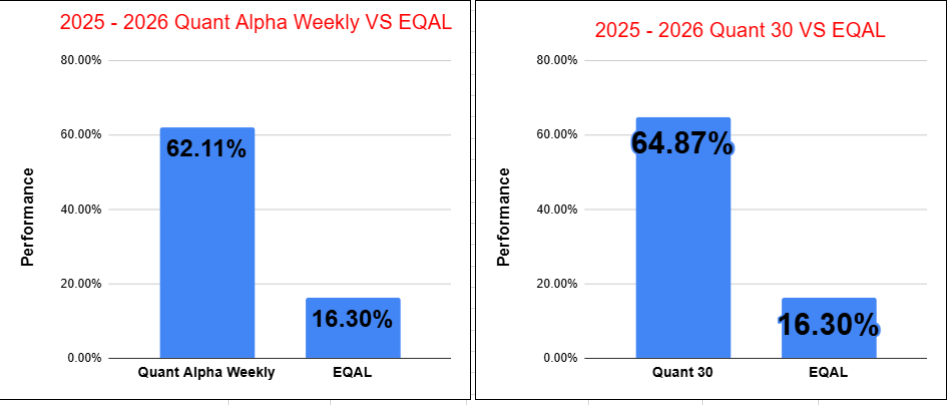
- Quant Weekly – Up over 62% since June 2025
- Quant 30 – Up over 64% since June 2025
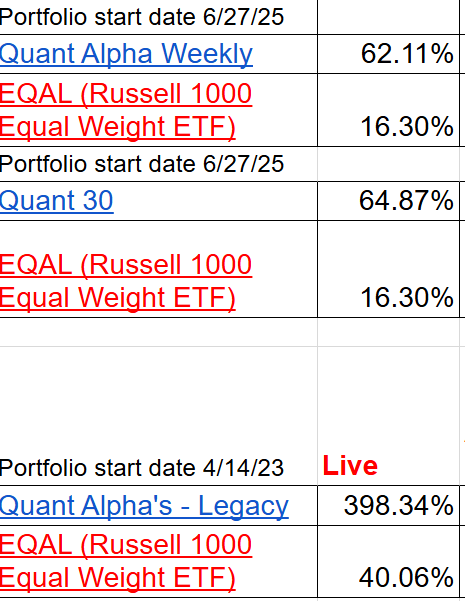
- Legacy – Up over 390% since April 2023
- Education – Why shorting stocks is not a good idea for most investors.
- Quick Links – At the bottom of the Post
USA Stock market week ending 05/15/26
Major Index Performance (Weekly)
- SPY (S&P 500 ETF) +0.2%
- The S&P 500 was relatively flat over the period, showing modest overall market resilience.
- DIA (Dow Jones Industrial Average ETF) -0.1%
- The Dow finished slightly lower, reflecting muted performance from large-cap industrial and value-oriented stocks.
- ^IXIC (Nasdaq Composite) -0.1%
- The Nasdaq was essentially unchanged, with technology and growth stocks consolidating after prior strength.
- IWM (Russell 2000 ETF) -2.3%
- Small-cap stocks materially underperformed large caps during the period, reflecting weaker relative momentum.
Takeaways
- Large-cap indexes remained relatively stable during the period despite mixed market performance underneath the surface.
- The Nasdaq and S&P 500 held near flat performance levels, suggesting continued resilience in major growth-oriented areas.
- Small caps lagged significantly, with the Russell 2000 posting the weakest performance among the major indexes.
Market Drivers this Week (05/18/26 – 05/22/26)
Friday, May 16 — Moody’s downgrade rattles the market
- Treasury yields are already climbing heading into the week, putting pressure on rate-sensitive sectors like REITs, utilities, homebuilders, and high-growth tech stocks.
Monday, May 18 — Iran tensions and Baidu earnings take center stage
- Iran’s Strait of Hormuz toll announcement may push oil prices higher, boosting energy names while potentially pressuring airlines, cruise lines, and consumer stocks; meanwhile Baidu $BIDU earnings will provide a major read on Chinese AI demand and tech spending momentum.
Tuesday, May 19 — Housing and consumer strength get tested
- Home Depot $HD, Toll Brothers $TOL, and CAVA $CAVA report earnings alongside April housing starts and building permits data, giving investors a broad look at housing demand and consumer spending trends under elevated mortgage rates.
Wednesday, May 20 — NVIDIA and the Fed could move the entire market
- NVIDIA $NVDA reports after the close in what may be the most important earnings release of the year, while Fed minutes earlier in the day could shift expectations on interest rates; Lowe’s $LOW, TJX $TJX, Williams-Sonoma $WSM, and Intuit $INTU also report.
Thursday, May 21 — Walmart and Deere provide key economic reads
- Walmart $WMT earnings will offer one of the clearest signals on U.S. consumer health, while Deere $DE results will give insight into industrial, agricultural, and equipment demand trends.
Friday, May 22 — Options expiration could amplify volatility
- Weekly options expiration and post-earnings positioning after NVIDIA may increase market swings and profit-taking activity heading into the weekend.
The CNN Fear and Greed Index ends the week at Greed 63. This is the fifth week in row at the Greed setting. This follows nine straight weeks at the Fear or Extreme Fear setting. Risk-on continues to be in the drivers seat and the market reflecting this over the last five weeks.
The Quant 30, Quant Weekly and Quant Legacy Model Portfolios all finished lower this week. The momentum stocks lost a little sparkle and generally gave up some recent gains. This breaks the string of seven up weeks in row.

Note: You are enjoying the free subscriber newsletter. Paid subscribers enjoy instant access to weekly Model Portfolio updates upon release and a Top Quant Stocks list. Free subscribers get access to Portfolio updates after a three-week delay but no Top Quant Stocks list. Want timely access to the new Adds/Removes and Top Quant Stocks list? Subscribe
Model Portfolio Quant Alpha Weekly
Any newly added stock is being released to Paid Subscribers today. Below are the updates from three weeks ago. This Portfolio continues to significantly outperform its benchmark, 62% versus 16%. It has 25 members.
Top five Quant stocks in the Portfolio (Paid subscribers only).
Add (04/24/26) : ICHR (Ichor Holdings) – Semiconductor Equipment
Remove (04/24/26) : None
Outperformers: SSRM (SSR Mining) up over +90%, MU (Micron Technology) up over +360%, VISN (Vistance Networks) up over +170%
Model Portfolio Quant 30
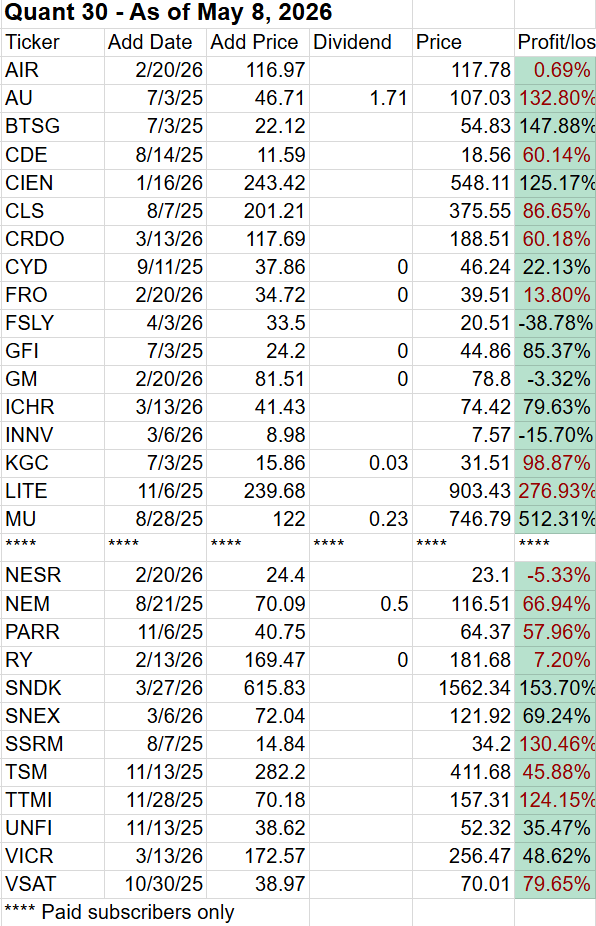
This week’s new update, if any, is being released to the paid subscribers. Shown below is the update made three weeks ago. This Portfolio continues to beat its benchmark by a wide margin, 62% to 16%. It has 30 members in it.
StoneX Group (SNEX) had a 3X2 stock split. It’s price has been adjusted accordingly.
Top five Quant stocks in the Portfolio (Paid subscribers only).
Add (04/24/26): None
Remove (04/24/26): None
Outperformers: MU (Micron Technology) up over +490%, LITE (Lumentum Holdings) up over +300%, TTMI (TTM Technologies) up over +130%, BTSG (BrightSpring Health) up over +160% and SNDK (Sandisk) up over +120%
Model Portfolio Quant Alpha’s – Legacy
The portfolio is up over +390% since it began in 2023. It has 18 stocks in it. Powell industries is now a 15 bagger. Celestica is now a 14 bagger and now Sterling Infrastructure has become a 13 bagger.
Top five Quant stocks in the Portfolio (Paid subscribers only).
Remove (04/24/26): None
Outperformers: AGX (Argan) up over +900%, STRL (Sterling Infrastructure) up over +1300%, POWL (Powell Industries) up over +1500% and CLS (Celestica) is up over +1400%

Performance to 05-15-2026
Top Quant Stocks for this week – (Paid subscribers only feature)

Why shorting stocks is not a good idea for most investors.
HOW SHORTING ACTUALLY WORKS –THE BASIC MECHANICS
- You borrow shares first
- Your broker lends you shares from someone else’s account
- You sell those borrowed shares immediately
- You’re selling something you don’t own — welcome to shorting
- Now you owe those shares back
- Doesn’t matter what happens — you got to return the same number of shares
- You wait for the price to drop
- That’s the whole bet: lower price later = profit
- You buy the shares back (this is called “covering”)
- Hopefully at a lower price
- You return the shares to the broker
- Trade closed, books balanced
- Your profit = sell price – buyback price (minus fees)
- Simple math… brutal consequences if wrong
WHAT YOU PAY ALONG THE WAY
- Borrow fee (stock loan fee)
- Hard-to-borrow stocks? You’re paying up daily
- Margin requirements
- You need collateral — broker is not trusting you for free
- Interest on borrowed money
- Especially if you’re using margin
- Dividends (yep, you pay those too)
- If the stock pays a dividend, you owe it to the lender
WHAT CAN GO WRONG (AND FAST)
- Stock goes up — you’re losing immediately
- No ceiling on losses… it can keep going
- Margin call hits
- Broker says “add cash or we close you out”
- Short squeeze
- Everyone rushes to cover → price spikes → you get smoked
- Borrow gets pulled
- Shares recalled → you’re forced to cover early
QUICK EXAMPLE (REAL SIMPLE)
- You short a stock at $100
- It drops to $70 → you buy it back
- You pocket $30 per share (minus fees)
But…
- It goes to $150 → now you’re down $50
- It goes to $300 → now it’s getting ugly real fast

THE TRUTH ABOUT PROFITABILITY
- Most people lose money shorting — straight up
- Around ~70% of short positions lose money in strong markets
- Even pros struggle — this is not easy money
- Some periods show ~75% of shorts unprofitable during rallies
- Retail success exists — but it’s rare and selective
- Only a small subset of “informed” traders consistently profit on specific trades
PROS OF SHORTING (WHY PEOPLE DO IT)
- You can make money when stocks go down
- Bear market? You’re eating while everyone else is starving
- Hedge your portfolio
- Offsets long positions — keeps your book balanced
- Exposes overvalued garbage
- Short sellers often sniff out frauds and hype stocks early
- Faster gains when you’re right
- Stocks fall quicker than they rise — panic is powerful
- Adds flexibility to your strategy
- You’re not just sitting there waiting for bull markets
- Improves market efficiency
- Helps correct overpriced nonsense
- Great for tactical trades
- Event-driven setups (earnings misses, bad news) can pay fast
- Leverage potential
- You don’t need full capital upfront (margin)
- Works in sideways/choppy markets
- Not everything needs to go up for you to win
- Psychological edge (if disciplined)
- Forces you to think critically, not just blindly bullish
CONS OF SHORTING (WHERE PEOPLE GET WRECKED)
- Losses are UNLIMITED
- Stock can go to infinity — your loss can too
- Win rate is stacked against you
- Most short trades lose money, especially in bull markets
- Short squeezes will humble you fast
- You’re right… until you’re forced to buy higher
- Timing has to be perfect
- Being early = being wrong
- Borrow costs eat your profits
- You’re paying to stay in the trade
- Margin calls = forced losses
- Broker can close you out at the worst possible time
- Market bias is UP over time
- You’re fighting the long-term trend
- Crowded trades can explode
- Everyone short = rocket fuel upward
- Emotional pressure is brutal
- Watching losses expand fast isn’t for beginners
- Limited upside, massive downside
- Best case = stock goes to zero… that’s it
BOTTOM LINE
- Shorting isn’t investing — it’s gambling
- Pros use it to hedge or exploit specific setups, not live off it
- If you don’t have discipline, timing, and risk control…
the market will run you over and not even slow down

Quick Links
- Live Scorecard
- Model Portfolio Quant Alpha Weekly
- Click here for the Quant Alpha Weekly details
- Model Portfolio Quant 30
- Click here for the Quant 30 details
- Model Portfolio Quant Alpha’s – Legacy
- Click here for the Quant Alpha’s – Legacy details
- Position Trader educational blog posts
- Position Trader – blog post user guide
All content on this site is for informational purposes only and does not constitute financial advice. Consult relevant financial professionals in your country of residence to get personalized advice before you make any trading or investing decisions. This post was written with the assistance of artificial intelligence. The original ideas and final review are human-generated. Disclaimer
Copyright 2023-2026 SwingTrader.Trading. All Rights Reserved.


You must be logged in to post a comment.