
- Understanding Market Reality
- Risk: What It Really Means
- The Role Of Psychology And Cycles
- Finding Value And Buying Well
- Related Video
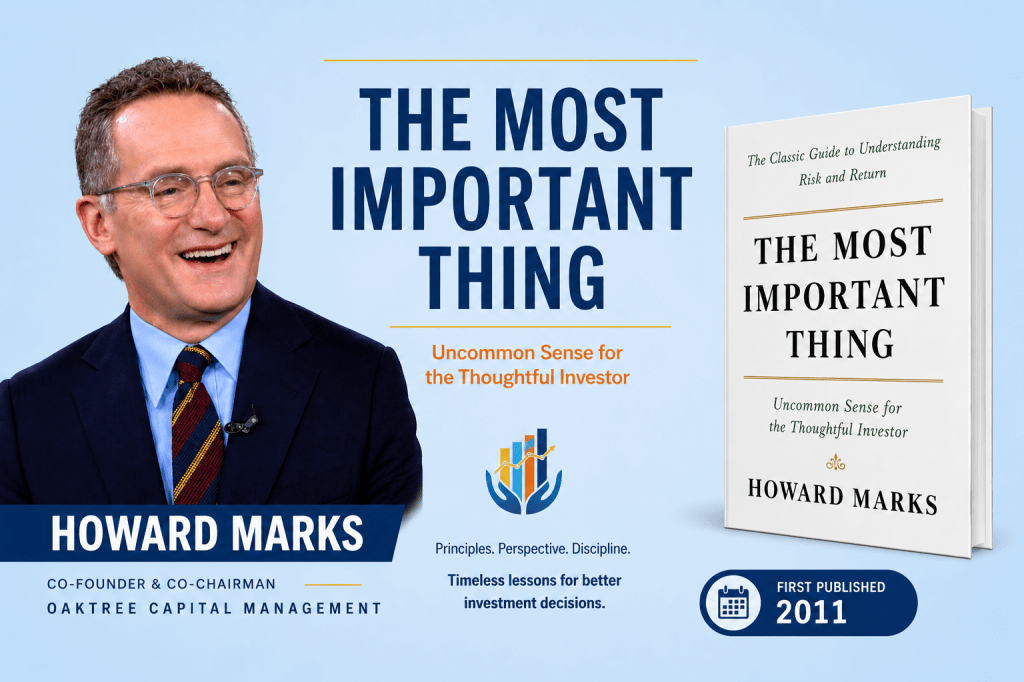
Below are some highlights from the best selling book The Most Important Thing by Howard Marks. The book was written in 2011. The Most Important Thing explains the keys to successful investment and the pitfalls that can destroy capital or ruin a career. Utilizing passages from his memos to illustrate his ideas, Marks teaches by example, detailing the development of an investment philosophy that fully acknowledges the complexities of investing and the perils of the financial world. Brilliantly applying insight to today’s volatile markets, Marks offers a volume that is part memoir, part creed, with a number of broad takeaways.
Highlights
Understanding Market Reality
The Market Is Not Your Friend
Markets aren’t perfectly rational. Prices are driven by emotion, fear, greed, and crowd behavior just as much as fundamentals. Marks believes investors should stop assuming the market is always correct — and start treating every price as a negotiation between imperfect human beings.
Most Investors Are Average By Definition
If you do what everyone else does, you’ll get what everyone else gets. Outperforming requires independent thinking, discipline, and the willingness to occasionally look wrong before being proven right. Being different isn’t enough — you have to be differently correct.
Second-Level Thinking Is The Whole Game
First-level thinking says “this is a great company.” Second-level thinking asks “does everyone already know that, and is the stock already priced for perfection?” Great investing comes from thinking deeper than consensus — and then acting on it when the crowd hasn’t caught up yet.
Know What You Don’t Know
Marks is sharper on this than most summaries give him credit for. He doesn’t just say forecasting is hard — he says macro forecasting is largely useless, and that investors who try to predict economies and markets tend to underperform those who focus on valuation discipline. Acknowledging uncertainty isn’t weakness. It’s one of the most powerful edges you can have.
The Future Is A Range Of Possibilities
Investing is about probabilities, not certainty. Great investors don’t ask “what will happen?” They ask “what could happen, how likely is each outcome, and am I being compensated appropriately for the range of risks?” That mental shift changes everything about position sizing and risk management.
History Repeats — But Never Exactly
Markets move in cycles. Studying past bubbles, crashes, and recoveries helps investors recognize dangerous behavior before it gets extreme. The patterns are real. The timing and trigger are never identical — which is exactly why experience alone isn’t enough and why complacency is always lurking.
Risk: What It Really Means
Risk Is Not Volatility — It’s Permanent Loss
Marks believes the finance industry’s obsession with volatility as a proxy for risk is fundamentally misguided. Real risk is losing capital you can’t recover. Short-term price swings only become dangerous when they force you into a bad decision — like selling at the bottom because you can’t stomach the drawdown.
Risk And Return Always Travel Together
Higher potential returns always require accepting higher risk. This isn’t just a platitude — it’s a diagnostic tool. Whenever someone offers you outstanding returns with minimal risk, either they’re wrong about the returns or they’re hiding the risk. There is no free lunch, and the people who believe there is tend to find out the hard way.
The Riskiest Time Is When Everyone Feels Safe
This is one of Marks’ sharpest and most counterintuitive points. When investors are confident, they accept lower compensation for the risk they’re taking. Valuations rise, leverage increases, and caution gets dismissed as timidity. That complacency is exactly when markets become most dangerous — not when everyone is already scared.
You Can’t Judge Risk By The Outcome
A risky decision that worked out was still a risky decision. A cautious decision that missed upside was still the right process. Marks is insistent on this: outcomes don’t retroactively define the quality of the decision. Good investing is about building a sound process and accepting that even good processes produce bad outcomes sometimes.
Controlling The Downside Matters Most
Marks built his entire career around asymmetric outcomes — losing less when things go wrong while still participating when things go right. Avoiding large, permanent losses is the foundation of long-term compounding. A 50% loss requires a 100% gain just to break even. The math of ruin is brutal.
Concentration Can Destroy Portfolios
Even strong, disciplined investors can be wiped out by a single oversized mistake. Survival isn’t just a nice goal — it’s the prerequisite for everything else. You cannot compound wealth if you aren’t still in the game. Marks treats capital preservation not as a conservative instinct but as a strategic necessity.
The Role Of Psychology And Cycles
Cycles Are Inevitable
Markets, economies, and investor sentiment all move in cycles. But Marks is more specific than most — he pays particular attention to the credit cycle, which he views as one of the most reliable leading indicators available. When credit is loose and lenders stop asking hard questions, that’s a warning sign more useful than almost any macro forecast.
Greed And Fear Run The Market
Bull markets are driven by greed. Bear markets are driven by fear. The dangerous part is that both feel completely rational to the people experiencing them. The best investors stay calibrated during both — neither dismissing risk during euphoria nor abandoning sound assets during panic.
The Pendulum Always Swings Too Far
Markets don’t settle at fair value — they overshoot dramatically in both directions. Extreme optimism produces prices that can only disappoint. Extreme fear produces prices that almost guarantee recovery for patient buyers. The pendulum always swings back, and the investors who profit most are the ones who resist the emotional pull of wherever it currently sits.
Consensus Thinking Feels Safe — But Can Be Dangerous
The crowd is usually comfortable and usually approximately right — except at turning points, which is exactly when it matters most. Successful investors develop the ability to form independent conclusions and act on them even when the consensus feels overwhelming. That’s not contrarianism for its own sake. It’s intellectual honesty.
Bull Markets Create Complacency
Long bull markets gradually lower standards. Deals get done at prices that would have been rejected earlier. Leverage increases. Covenants weaken. Risk gets reframed as opportunity. This is how the seeds of the next crash get planted during the current boom — not through sudden recklessness, but through the slow erosion of discipline.
Your Emotional State Matters
Emotional discipline is one of the most durable investing edges available. Fear and greed don’t just affect bad investors — they affect everyone. The difference is that the best investors have built a process sturdy enough to override those impulses in the moments when they’re loudest. Without that, even a sound analytical framework will fail you.
Finding Value And Buying Well
Price Is Everything
A great company at a terrible price is a terrible investment. A mediocre company at a wonderful price can be an excellent one. Valuation discipline isn’t just one factor among many — it’s the factor that most reliably determines whether you make or lose money over time.
You Make Your Money When You Buy
Strong long-term returns are almost always traceable back to disciplined entry prices. By the time you’re ready to sell, your fate is largely already decided. The margin of safety gets built in at the purchase, not discovered afterward.
The Goal Is To Find Mispriced Assets
Marks isn’t just looking for cheap assets — he’s looking for assets the market has priced incorrectly relative to their true underlying value. That usually requires doing serious work on something unloved, misunderstood, or temporarily out of favor, and having enough conviction to act against the prevailing mood.
Distressed Debt Can Create Real Opportunity
This is where Marks made his name, and his conviction goes well beyond “risks are real.” His actual argument is that market inefficiency in distressed situations is structural — panic selling, forced liquidations, and investor mandates that prohibit holding below-investment-grade paper all create mispricings that have nothing to do with actual recovery value. For disciplined analysts willing to do the work, that gap between price and value is where exceptional returns live.
The Most Popular Ideas Are Often Overcrowded
When everyone loves the same investment, expectations and valuations are already stretched to reflect the good news. The upside is priced in and the downside is ignored. Some of the best opportunities in markets are in the places nobody is talking about, precisely because indifference keeps prices low.
Building A Philosophy And Staying Disciplined
Philosophy Comes Before Strategy
Before deciding what to buy, you need a clear framework for how markets work, where edges come from, and how you’ll behave across different environments. Without that foundation, every headline becomes a reason to change course, and emotions fill the vacuum where process should be.
Consistency Through Cycles Matters
Anyone can look smart during a bull market. The real test is whether your process holds up when conditions turn hostile. Marks values investors who maintain discipline across full cycles far more than those who generate spectacular short-term results and then blow up when the environment shifts.
Understanding The Cycle Helps Determine Aggression
When valuations are stretched, credit is loose, and sentiment is euphoric, the right move is caution — even when it feels like you’re missing out. When assets are cheap, credit is tight, and fear dominates, the right move is aggression — even when it feels terrifying. Marks knows this is easy to say and incredibly hard to execute emotionally.
Leverage Amplifies Everything
Borrowed money turns modest gains into impressive ones and manageable losses into catastrophic ones. Marks treats leverage with deep respect and views reckless use of it as one of the most reliable paths to ending your investing career. The math works against you when things go wrong under leverage — and things always go wrong eventually.
Survival Comes First
You cannot compound wealth if you blow yourself up. Marks is unambiguous: preserving the ability to stay in the game is the first rule of investing. Every other principle — value, patience, contrarianism — only matters if you’re still around to apply it.
Great Investing Is About Playing The Odds
Even the best investors are wrong regularly. The goal isn’t perfection — it’s building a repeatable process where the wins are bigger than the losses over time, and where the probabilities consistently tilt in your favor. Marks is fundamentally probabilistic. He accepts uncertainty and works to position himself correctly within it, not to eliminate it.
Summary
- Risk is the central theme. Nearly every lesson in the book circles back to understanding, measuring, and managing risk — not avoiding it entirely, but ensuring you’re compensated fairly for what you accept and that no single mistake can end you.
- The credit cycle is Marks’ most specific and underrated insight. Most summaries reduce him to generic cycle-watching, but his sharpest early-warning signal is credit conditions — loose lending, weakening covenants, and disappearing standards are more predictive than almost any macro forecast.
- Second-level thinking is the engine of outperformance. The skill isn’t spotting good businesses — it’s figuring out what the consensus already believes and identifying where the price diverges from reality in your favor.
- Macro forecasting is not just hard — Marks considers it largely useless. Investors who build strategies around predicting economies and interest rates tend to underperform those who focus relentlessly on what assets are worth and what they cost today.
- Process and philosophy outlast any single insight. Markets change, cycles turn, and hot strategies go cold. What survives across all of it is intellectual humility, emotional discipline, and a framework rigorous enough to hold when the pressure to abandon it is greatest.
All content on this site is for informational purposes only and does not constitute financial advice. Consult relevant financial professionals in your country of residence to get personalized advice before you make any trading or investing decisions. This post was written with the assistance of artificial intelligence. The original ideas and final review are human-generated. Disclaimer
Copyright 2023-2026 SwingTrader.Trading. All Rights Reserved.


You must be logged in to post a comment.