
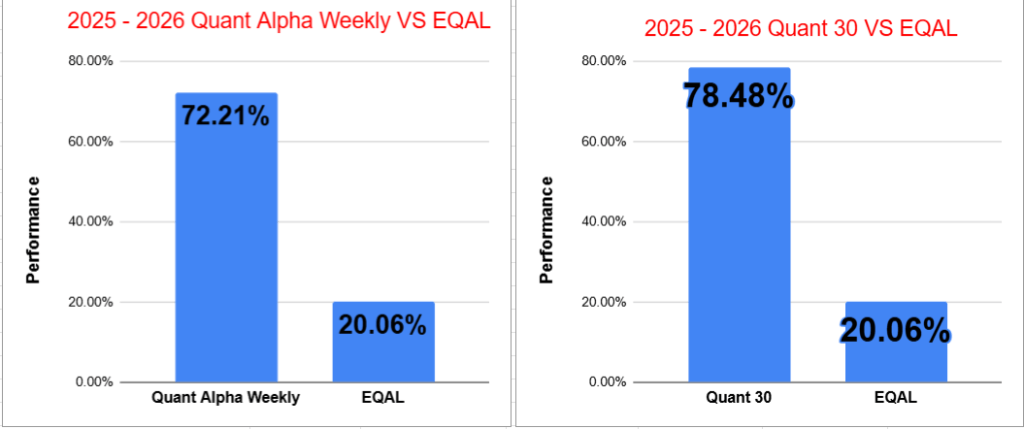
- Quant Weekly – Up over 72% since June 2025
- Quant 30 – Up over 78% since June 2025
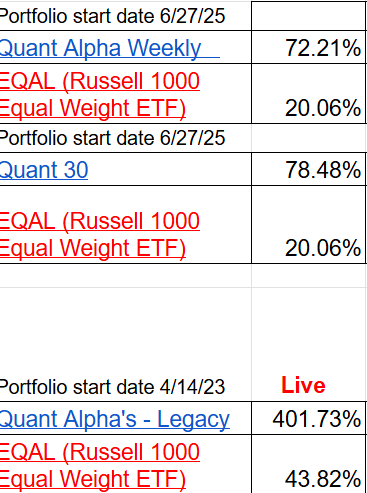
- Legacy – Up over 401% since April 2023
- Education – Pattern Day Trader (PDT) rules change on June 4, 2026
- Quick Links – At the bottom of the Post
USA Stock market week ending 05/29/26
Major Index Performance (Weekly)
- The S&P 500 (SPY) gained +1.5% from the close of 05/18/26 through the close of 05/22/26, continuing to show broad large-cap market strength.
- The Dow Jones Industrial Average (DIA) advanced +0.9% for the week, with blue-chip stocks posting steady gains.
- The Nasdaq Composite (^IXIC) led the major indexes with a strong +2.4% rally, outperforming the broader market during the period.
- The Russell 2000 (IWM) climbed +1.3% for the week, showing improving participation from small-cap stocks.
Market Drivers this Week (06/01/26 – 06/05/26)
- Monday 6/01/26 — Manufacturing Numbers Hit the Tape
- S&P Global Manufacturing PMI and ISM Manufacturing both release in the morning.
- Strong readings would support the ongoing industrial and AI infrastructure strength narrative.
- JOLTS Job Openings also hits at 10:00 AM ET and remains one of the Fed’s key labor market indicators.
- Any Iran ceasefire extension headlines over the weekend could sharply move oil prices and energy-sensitive stocks Monday morning.
- Tuesday 6/02/26 — CrowdStrike and HPE Earnings
- CrowdStrike reports after the bell and could move the cybersecurity sector.
- Hewlett Packard Enterprise also reports and gives investors another read on AI server demand after Dell’s strong quarter.
- Factory Orders data releases Tuesday morning and will provide another look at industrial demand trends.
- Wednesday 6/03/26 — Jobs Data and Broadcom Earnings
- ADP Private Payrolls releases before the open and gives traders an early read on the labor market.
- ISM Services PMI follows at 10:00 AM ET and remains important since services drive most of the U.S. economy.
- EIA Crude Oil Inventories also release during the morning session and could move energy markets.
- Broadcom reports after the close and is expected to be one of the week’s biggest AI-related earnings events.
- Thursday 6/04/26 — Jobless Claims and Veeva Earnings
- Weekly Initial Jobless Claims releases before the open and remains one of the market’s most closely watched labor indicators.
- Veeva Systems reports after the close and could impact healthcare software and cloud names.
- Friday 6/05/26 — Jobs Report Takes Center Stage
- Nonfarm Payrolls releases at 8:30 AM ET and is the biggest economic report of the week.
The CNN Fear and Greed Index ends the week at 60. This is the seventh week in row at the Greed setting. This follows nine straight weeks at the Fear or Extreme Fear setting. Risk-on continues to be in the drivers seat and the market is reflecting this over the last seven weeks.
The Quant Model Portfolios all finished higher this week. Quant Weekly and Quant 30 made new all time highs. Quant Legacy moves back over +400%.

Note: You are enjoying the free subscriber newsletter. Paid subscribers enjoy instant access to weekly Model Portfolio updates upon release and a Top Quant Stocks list. Free subscribers get access to Portfolio updates after a three-week delay but no Top Quant Stocks list. Want timely access to the new Adds/Removes and Top Quant Stocks list? Subscribe
Model Portfolio Quant Alpha Weekly
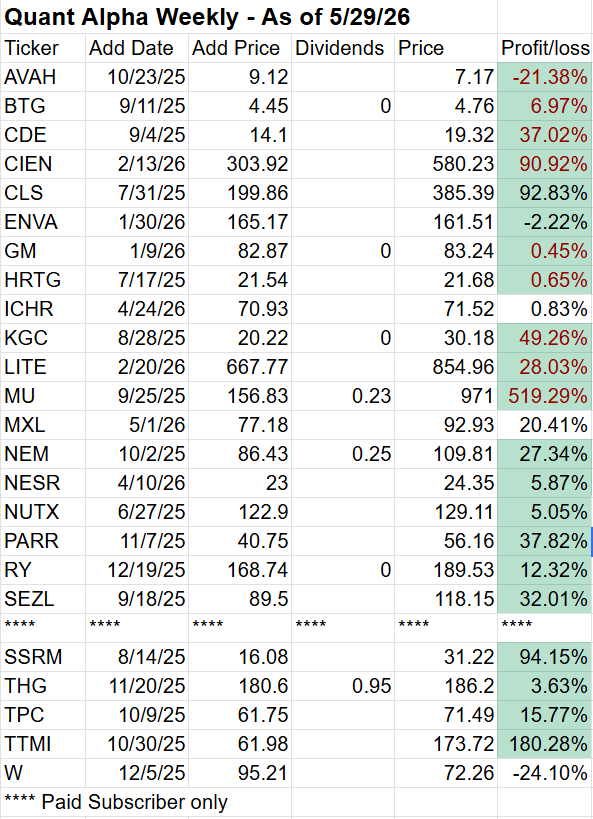
Any newly added stock is being released to Paid Subscribers today. Below are the updates from three weeks ago. This Portfolio continues to significantly outperform its benchmark, 72% versus 20%. It has 25 members.
Top five Quant stocks in the Portfolio (Paid subscribers only).
Add (05/08/26) : None
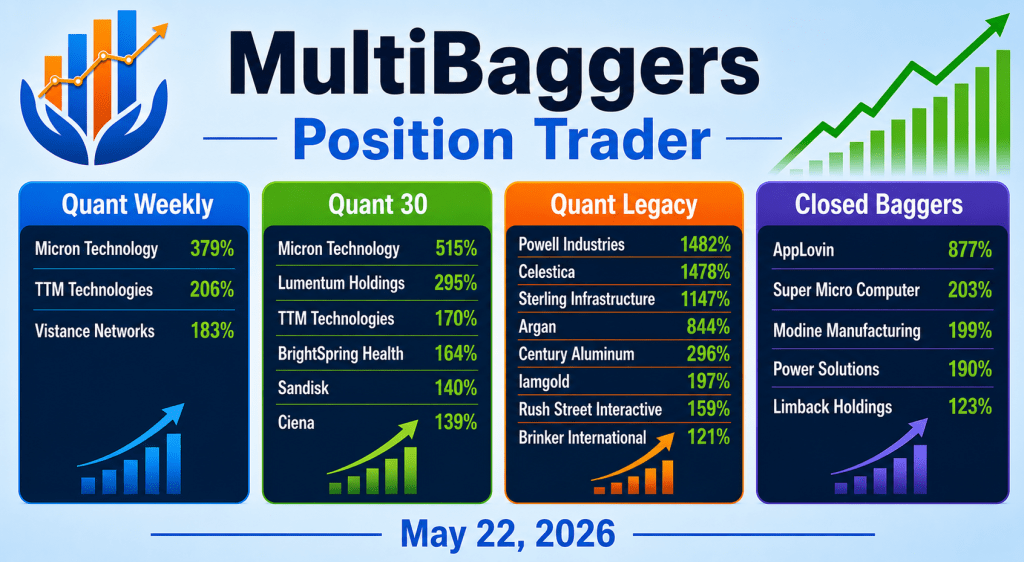
Outperformers: SSRM (SSR Mining) up over +90%, MU (Micron Technology) up over +510%, TTMI (TTM Technologies) up over +180%
Model Portfolio Quant 30
This week’s new update, if any, is being released to the paid subscribers. Shown below is the update made three weeks ago. This Portfolio continues to beat its benchmark by a wide margin, 78% to 20%. It has 30 members in it.
SSRM was added to the Portfolio on 8/7/25 and leaves the Portfolio with a +130% increase.
Top five Quant stocks in the Portfolio (Paid subscribers only).
Add (05/08/26): PBR-A (Petrobras) Oil and Gas
Remove (05/08/26): SSRM (SSR Mining)
Outperformers: MU (Micron Technology) up over +690%, LITE (Lumentum Holdings) up over +250%, TTMI (TTM Technologies) up over +140%, BTSG (BrightSpring Health) up over +170% and SNDK (Sandisk) up over +170%
Model Portfolio Quant Alpha’s – Legacy
The portfolio is up over +400% since it began in 2023. It has 17 stocks in it. Powell industries is now a 15 bagger. Celestica is now a 15 bagger and now Sterling Infrastructure has become a 13 bagger.
Sterling Infrastructure had blow out earnings three weeks ago. It started the week at $532 and ended the week at $844. It is now a 13 bagger.
Top five Quant stocks in the Portfolio (Paid subscribers only).
Remove (05/01/26): None
Outperformers: AGX (Argan) up over +800%, STRL (Sterling Infrastructure) up over +1300%, POWL (Powell Industries) up over +1500% and CLS (Celestica) is up over +1500%

Performance to 05-29-2026
Top Quant Stocks for this week – (Paid subscribers only feature)

Pattern Day Trader (PDT) rules change on June 4, 2026
The Pattern Day Trader (PDT) framework is undergoing one of the biggest changes in modern retail trading regulation. The old FINRA day-trading system is being retired and replaced with a new intraday risk-based margin framework focused more on real-time exposure and leverage instead of simply counting trades.
Even thou most of us are not daytraders and were not impacted by the Pattern Day Trader rule, you could still run afoul of it by having an active swing trading account. This happened to me a couple of times and I got an official warning from my broker that if I did not cut it out they would freeze my account for a period of time. The new rule should prevent that from happening in the future but may create problems of its own as investors realized they can push the envelope further now.
What The Old PDT Rule Was
Under the old FINRA Rule 4210 system:
- If you made 4 or more day trades within 5 business days in a margin account, your account could be designated as a “Pattern Day Trader.”
- Once flagged, the account generally needed at least $25,000 equity to continue unrestricted day trading.
The rule primarily applied to:
- stocks,
- ETFs,
- options,
- and margin accounts.
Cash accounts were not subject to the PDT designation itself.
What’s Changing
The FINRA PDT Framework Is Being Replaced
FINRA and the SEC approved amendments replacing the old PDT-specific margin framework with a modernized intraday margin system.
The amendments remove:
- the PDT designation,
- the “4 trades in 5 days” trigger,
- and the PDT-specific $25,000 equity requirement.
However:
- brokers may still maintain internal trading controls,
- some firms may phase out old PDT operational policies gradually,
- and firms can still impose their own house margin requirements.
New System: Intraday Risk-Based Margin Monitoring
Instead of counting trades, brokers will monitor:
- intraday exposure,
- leverage,
- maintenance margin,
- concentration risk,
- and real-time account volatility.
The focus shifts from:
“How many trades did you make?”
to:
“How much intraday risk are you taking?”
Key Changes Retail Traders Will Notice
1. The PDT-Specific $25,000 Minimum Is Going Away
Retail traders will no longer face the old PDT-specific $25K requirement tied to day-trading designation.
However:
- brokers may still impose their own minimums,
- and normal federal margin-account requirements still apply.
Many firms may continue allowing standard margin accounts starting near traditional Regulation T minimum levels, but policies will vary broker-to-broker.
2. The “4 Trades In 5 Days” Trigger Is Being Removed
The old PDT trade-counting system is being retired. Traders will no longer automatically receive PDT designation simply for making multiple intraday round-trip trades.
Instead, restrictions will increasingly depend on:
- real-time margin exposure,
- leverage,
- and broker risk controls.
3. Brokers Will Use Dynamic Risk Controls
Even though the PDT framework is changing, brokers will still actively manage risk.
Firms may:
- reduce intraday buying power,
- issue intraday margin calls,
- restrict trading activity,
- or liquidate positions if account exposure becomes excessive.
So the system becomes:
- more flexible,
- but also more dynamic and risk-sensitive.
4. Buying Power May Change Intraday
Under the old PDT system:
- buying power calculations were often relatively static.
Under the new framework:
- buying power may adjust dynamically throughout the day based on:
- volatility,
- open positions,
- leverage,
- maintenance margin,
- and account concentration risk.
Effective Date
The new framework officially becomes effective:
June 4, 2026
Full Industry Transition Period
Broker-dealers have until approximately:
October 20, 2027 to fully transition operational systems and compliance procedures. This means implementation timing may differ across brokers.
What Brokers Are Saying
Some brokers have already indicated:
- PDT counting restrictions will disappear,
- the old PDT designation will be phased out,
- and risk controls will increasingly become intraday-margin based.
However:
- individual broker policies may still vary,
- and firms may implement additional safeguards beyond FINRA minimums.
What Is NOT Changing
Margin Risk Still Exists
This is not unlimited unrestricted leverage.
Traders can still:
- receive margin calls,
- face liquidations,
- or have buying power reduced if risk becomes too high.
Cash Accounts Still Follow Settlement Rules
Cash accounts still remain subject to:
- settlement timing requirements,
- freeriding restrictions,
- and good-faith violation rules.
Brokers Can Still Create House Rules
Even after the PDT framework changes:
- brokers may still impose:
- stricter margin rules,
- volatility controls,
- concentration limits,
- or additional trading restrictions.
Why Regulators Made The Change
FINRA argued the old PDT framework had become outdated and overly rigid.
Critics of the old system argued:
- smaller traders were unfairly restricted,
- while wealthier traders could take identical risks without limitations.
The new framework is designed to:
- modernize risk management,
- align restrictions with actual exposure,
- and reduce reliance on simple trade-count rules.
Risks And Criticism
Not everyone supports the changes. Critics worry the new system could encourage:
- more speculative trading,
- higher leverage usage,
- increased retail losses,
- and more volatility from short-term speculation.
Some investor-protection advocates believe the old PDT framework acted as a behavioral brake on inexperienced traders.
Bottom Line
The old FINRA Pattern Day Trader framework is being retired and replaced with a more modern intraday risk-based margin system.
The biggest practical changes are:
- removal of the PDT-specific $25K requirement,
- elimination of the fixed “4 trades in 5 days” trigger,
- and greater flexibility for active retail traders.
However:
- brokers will still monitor risk aggressively,
- intraday margin controls will remain active,
- and traders can still face restrictions or liquidations if leverage or exposure becomes excessive.
Quick Links
- Live Scorecard
- Model Portfolio Quant Alpha Weekly
- Click here for the Quant Alpha Weekly details
- Model Portfolio Quant 30
- Click here for the Quant 30 details
- Model Portfolio Quant Alpha’s – Legacy
- Click here for the Quant Alpha’s – Legacy details
- Position Trader educational blog posts
- Position Trader – blog post user guide
All content on this site is for informational purposes only and does not constitute financial advice. Consult relevant financial professionals in your country of residence to get personalized advice before you make any trading or investing decisions. This post was written with the assistance of artificial intelligence. The original ideas and final review are human-generated. Disclaimer
Copyright 2023-2026 SwingTrader.Trading. All Rights Reserved.


You must be logged in to post a comment.