
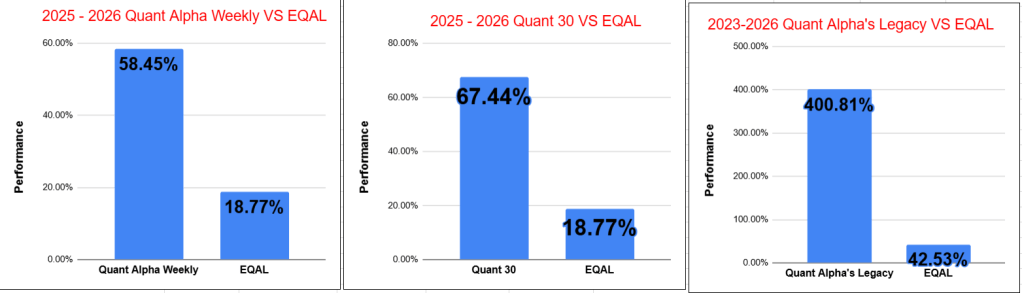
- Quant Weekly – Up over 58% since June 2025
- Quant 30 – Up over 67% since June 2025
- Legacy – Up over 400% since April 2023
- Education – When oil prices Drop 20% suddenly – Which industries benefit and which suffer?
- Quick Links – At the bottom of the Post
USA Stock market week ending 06/05/26
Major Index Performance (Weekly)
- The S&P 500 (SPY) declined -2.5% from the close of 06/01/26 through the close of 06/05/26, ending the week lower after a broad-market pullback.
- The Dow Jones Industrial Average (DIA) slipped -0.2%, making it the most resilient of the four major indexes during the week.
- The Nasdaq Composite (^IXIC) fell -4.7%, posting the largest decline among the major U.S. indexes.
- The Russell 2000 (IWM) dropped -3.0%, reflecting weakness across the small-cap segment of the market.
Market Drivers this Week (06/08/26 – 06/12/26)
- Monday 6/08 — China trade data could influence industrial, materials, and export-related stocks as investors assess global demand trends.
- Tuesday 6/09 — NFIB Small Business Optimism and Wholesale Inventories are released. After the close, Oracle (ORCL) reports earnings, with investors focused on cloud and AI growth.
- Wednesday 6/10 — CPI is the week’s biggest economic report and could significantly impact interest-rate expectations and market sentiment. The Bank of Canada also announces its rate decision.
- Thursday 6/11 — PPI, Weekly Jobless Claims, and the ECB rate decision headline a busy day of economic data and central-bank news. SpaceX prices its IPO.
- Friday 6/12 — University of Michigan Consumer Sentiment provides an updated look at consumer confidence and inflation expectations. SpaceX stock starts trading.
The CNN Fear and Greed Index ends the week at 42 back in the Fear area after seven weeks in the Greed area. It looks like risk off has returned, at least for a time.
The Quant Model Portfolios all lost ground last week along with nearly all momentum stocks as risk off regains control in the stock market. Momentum stocks lead the markets up and lead the markets down. Nothing new here. Stay patient!

Note: You are enjoying the free subscriber newsletter. Paid subscribers enjoy instant access to weekly Model Portfolio updates upon release and a Top Quant Stocks list. Free subscribers get access to Portfolio updates after a three-week delay but no Top Quant Stocks list. Want timely access to the new Adds/Removes and Top Quant Stocks list? Subscribe
Model Portfolio Quant Alpha Weekly
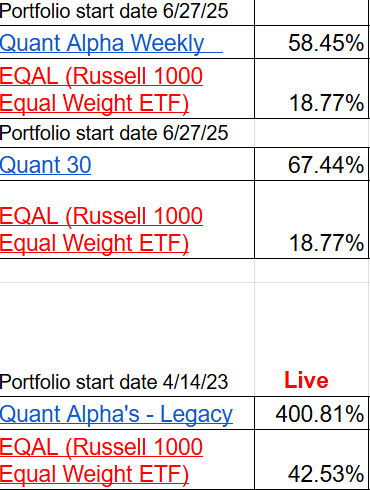
Any newly added stock is being released to Paid Subscribers today. Below are the updates from three weeks ago. This Portfolio continues to significantly outperform its benchmark, 58% versus 18%. It has 26 members.
Top five Quant stocks in the Portfolio (Paid subscribers only).
Add (05/15/26) : SNDK (Sandisk) Computer Hardware
Outperformers: SSRM (SSR Mining) up over +60%, MU (Micron Technology) up over +450%, TTMI (TTM Technologies) up over +170%
Model Portfolio Quant 30
This week’s new update, if any, is being released to the paid subscribers. Shown below is the update made three weeks ago. This Portfolio continues to beat its benchmark by a wide margin, 67% to 18%. It has ?? members in it.
CYD (China Yuchai International) was removed from the portfolio three weeks ago. It was added on 9/11/25 and was up 32% since being added.
Top five Quant stocks in the Portfolio (Paid subscribers only).
Add (05/15/26): ASX (ASE Technology) Semiconductors
Remove (05/15/26): CYD (China Yuchai International)
Outperformers: MU (Micron Technology) up over +600%, LITE (Lumentum Holdings) up over +260%, TTMI (TTM Technologies) up over +130%, BTSG (BrightSpring Health) up over +150% and SNDK (Sandisk) up over +150%
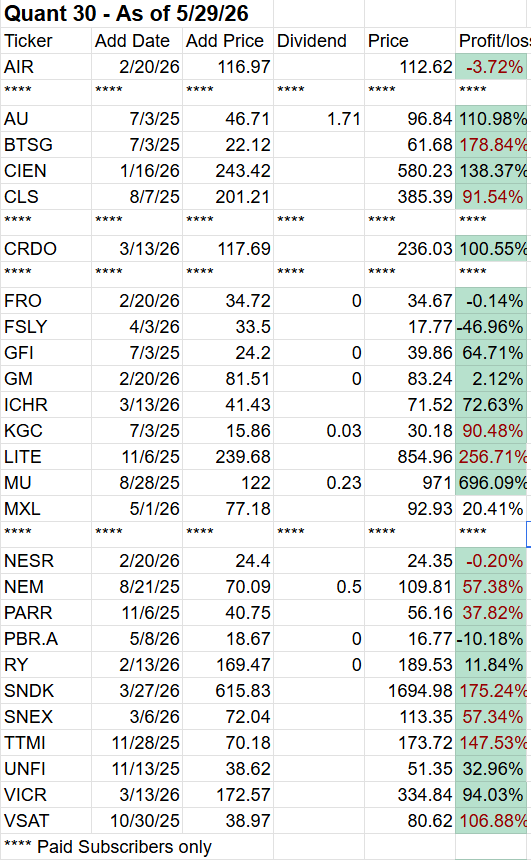
Model Portfolio Quant Alpha’s – Legacy
The portfolio is up over +400% since it began in 2023. It has 17 stocks in it. Powell industries is now a 15 bagger. Celestica is now a 14 bagger and now Sterling Infrastructure has become a 14 bagger.
WGS (GeneDx Holdings) received a hard sell from the Quant system three weeks ago. It has been removed. It was added 8/7/24 and leaves the Portfolio with a +40% profit.
Top five Quant stocks in the Portfolio (Paid subscribers only).
Remove (05/15/26): WGS (GeneDx Holdings)
Outperformers: AGX (Argan) up over +800%, STRL (Sterling Infrastructure) up over +1400%, POWL (Powell Industries) up over +1500% and CLS (Celestica) is up over +1400%

Performance to 06-05-2026
Top Quant Stocks for this week – (Paid subscribers only feature)

When oil prices Drop 20% suddenly – Which industries benefit and which suffer?
Industries That Benefit Most
Airlines benefit the fastest
Jet fuel is one of the largest airline expenses, so lower oil prices quickly improve margins for carriers like Delta Air Lines, United Airlines, and Southwest Airlines. Airline stocks often rally quickly when oil falls sharply.
Trucking and logistics see lower fuel costs
Diesel prices drop alongside oil, helping transportation companies like FedEx, UPS, and J.B. Hunt improve profitability and operating efficiency.
Consumers usually spend more elsewhere
Lower gas prices act like a tax cut for households, often boosting spending on restaurants, travel, retail, and entertainment within a few quarters.
Chemical companies benefit from cheaper inputs
Lower oil and natural-gas prices reduce feedstock costs for chemical manufacturers like Dow and LyondellBasell, helping expand margins.
Some utilities benefit modestly
Utilities with unregulated or fuel-sensitive operations may see some cost relief, although most regulated utilities eventually pass fuel savings through to customers.

Industries Most Negatively Impacted
Exploration and production companies get hit hardest
Oil producers face immediate revenue pressure when crude prices fall, while drilling costs, debt payments, and lease obligations remain largely fixed.
Oilfield services companies suffer quickly
Companies like Halliburton and SLB depend on drilling activity, so lower oil prices often lead to rapid cuts in energy spending and rig activity.
Oil-dependent economies and energy stocks weaken
Countries and markets heavily dependent on oil exports can face fiscal pressure, weaker currencies, and slower economic growth during sustained oil declines.
Integrated oil majors feel pressure but remain more resilient
Large companies like Exxon Mobil, Chevron, and Shell are affected by lower crude prices, although refining and downstream operations can partially offset upstream weakness.
Renewable energy sentiment can soften
Lower gasoline prices may temporarily reduce urgency around EV adoption and energy-transition themes, though long-term renewable demand is still driven heavily by policy, technology, and infrastructure trends.
Summary
A sharp oil-price decline generally shifts economic benefit away from oil producers and toward consumers, transportation companies, and fuel-intensive industries. The overall impact depends heavily on:
- hedging strategies,
- debt levels,
- operating leverage,
- and whether the oil decline is viewed as temporary or long lasting.
Companies Most Likely to Benefit — Ranked by Impact
Airlines — Biggest Direct Winners
Southwest Airlines
Southwest currently has limited fuel hedging exposure, making it highly sensitive to lower jet fuel prices. A major oil decline could significantly improve margins and earnings expectations.
United Airlines
United carries substantial fuel-cost exposure, so lower oil prices can quickly improve profitability and cash flow.
American Airlines
American’s thinner balance sheet makes fuel relief especially important, with lower jet fuel costs helping liquidity and earnings.
Delta Air Lines
Delta benefits from lower fuel costs as well, although its refinery operations provide some partial insulation compared to peers.
Alaska Airlines
Alaska remains highly fuel-sensitive, meaning lower oil prices can materially improve operating margins.
Trucking and Logistics — Fast Margin Improvement
Old Dominion Freight Line
Lower diesel prices can directly improve margins for one of the most efficient freight operators in the industry.
J.B. Hunt
J.B. Hunt benefits across both trucking and intermodal operations from lower transportation fuel costs.
UPS & FedEx
Both companies operate massive delivery fleets, making lower diesel prices a meaningful earnings tailwind.
Consumer and Travel Beneficiaries
McDonald’s & Yum! Brands
Lower gas prices often increase discretionary spending on dining and travel.
Target & Walmart
Consumers typically spend more on discretionary purchases when fuel expenses decline.
Royal Caribbean & Carnival Corporation
Cruise operators benefit from both lower fuel costs and stronger consumer travel demand.
Chemical Companies
Dow & LyondellBasell
Lower oil and natural-gas prices reduce feedstock costs and can support margin expansion.
Companies Most Likely to Suffer
Exploration and Production Companies
Devon Energy & ConocoPhillips
Lower oil prices directly reduce cash flow, earnings, dividends, and buyback capacity for oil producers.
Smaller Independent Producers
Higher-cost and more leveraged E&P companies face the greatest pressure during sustained oil-price declines.
Oilfield Services
SLB & Halliburton
Lower oil prices often trigger drilling and capital-spending cuts, reducing demand for oilfield services.
Integrated Oil Majors
Exxon Mobil & Chevron
Integrated majors remain profitable during moderate oil declines, but lower crude prices can pressure earnings, buybacks, and future cash-return expectations.
Renewable Energy
Tesla, Enphase Energy & Sunrun
Lower gasoline prices can temporarily weaken EV and clean-energy sentiment, although long-term renewable adoption still depends heavily on regulation, technology, and infrastructure trends.
Bottom Line
A sharp oil-price decline generally shifts economic benefit away from oil producers and toward consumers, transportation companies, airlines, and fuel-intensive industries. The biggest winners are usually airlines, trucking, logistics, and consumer-facing businesses, while the biggest pressure typically falls on oil producers, oilfield services firms, and energy-dependent economies.
Quick Links
- Live Scorecard
- Model Portfolio Quant Alpha Weekly
- Click here for the Quant Alpha Weekly details
- Model Portfolio Quant 30
- Click here for the Quant 30 details
- Model Portfolio Quant Alpha’s – Legacy
- Click here for the Quant Alpha’s – Legacy details
- Position Trader educational blog posts
- Position Trader – blog post user guide
All content on this site is for informational purposes only and does not constitute financial advice. Consult relevant financial professionals in your country of residence to get personalized advice before you make any trading or investing decisions. This post was written with the assistance of artificial intelligence. The original ideas and final review are human-generated. Disclaimer
Copyright 2023-2026 SwingTrader.Trading. All Rights Reserved.


You must be logged in to post a comment.