
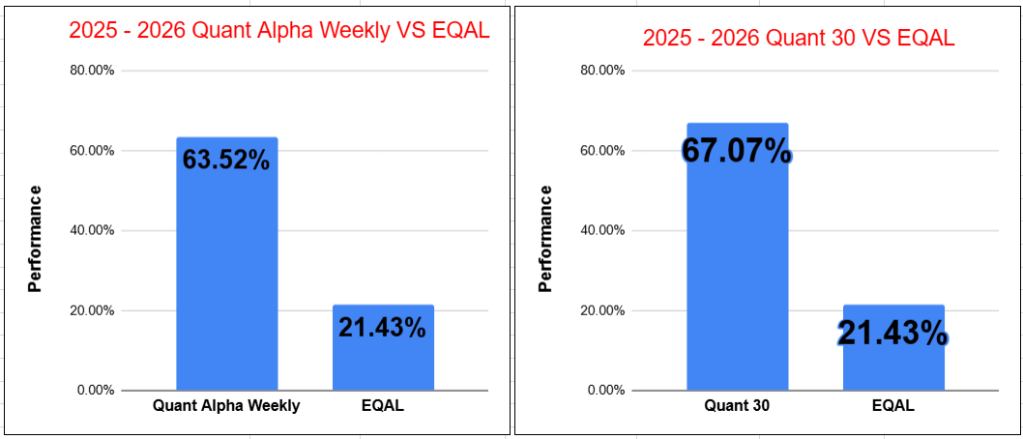
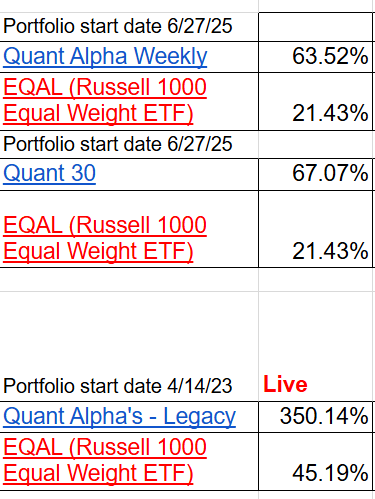
- Quant Weekly – Up over 63% since June 2025
- Quant 30 – Up over 67% since June 2025
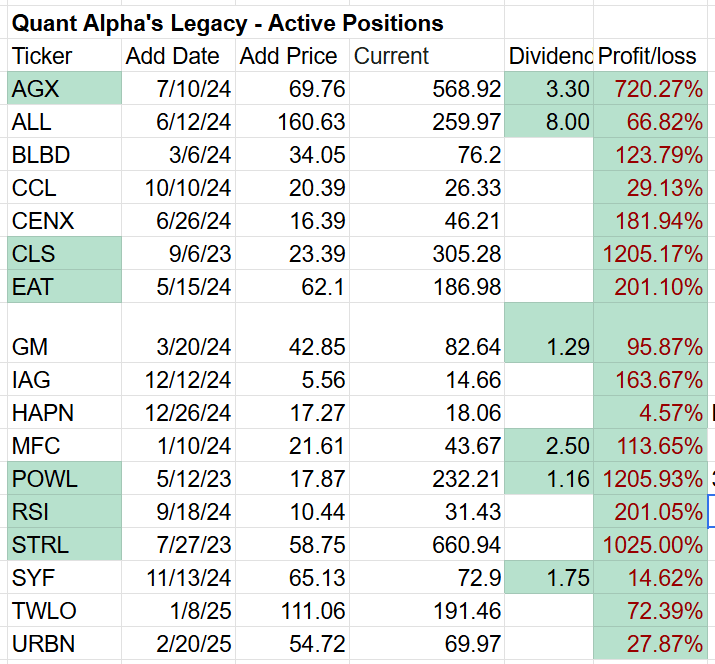
- Legacy – Up over 350% since April 2023
- Education – Is a Spinoff Announcement a Good Time to Buy the Stock?
USA Stock market week ending 07/24/26
- S&P 500 (SPY):-0.6% — The broad market posted a modest weekly decline as investors became more cautious after recent gains.
- Dow Jones Industrial Average (DIA):-0.4% — Blue-chip stocks slipped slightly, outperforming most of the major indexes.
- Nasdaq Composite (^IXIC):-2.1% — Technology and growth stocks led the market lower, making the Nasdaq the weakest major index for the week.
- Russell 2000 (IWM):-1.0% — Small-cap stocks declined as investors shifted toward larger, more defensive companies.
- Invesco S&P 500 Momentum ETF (SPMO):+1.8% — Momentum stocks bucked the broader market, extending their relative strength and significantly outperforming the major indexes.
Market Drivers this Week (07/27/26 – 07/31/26)
Monday, 7/27 — Durable Goods & Earnings Begin
- Durable Goods Orders (8:30 AM ET) provide an early look at business investment.
- Key earnings: Cadence Design Systems, Nucor, Welltower, Universal Health Services, UDR, and Cincinnati Financial.
Tuesday, 7/28 — Consumer Confidence & Busy Earnings Day
- Consumer Confidence (10:00 AM ET) highlights consumer sentiment.
- Key earnings: Boeing, Visa, UPS, Coca-Cola, PayPal, Ford, Hilton, Mondelez, NXP Semiconductors, KLA, Sherwin-Williams, and Centene.
- The Federal Reserve’s two-day policy meeting begins.
Wednesday, 7/29 — Fed Decision Takes Center Stage
- FOMC interest-rate decision (2:00 PM ET) followed by Chair Kevin Warsh’s press conference (2:30 PM ET).
- Key earnings: Procter & Gamble, ServiceNow, Humana, Boston Scientific, Garmin, Cigna, and UBS.
Thursday, 7/30 — Mega-Cap Tech Earnings
- Weekly Initial Jobless Claims are released before the market opens.
- Key earnings: Apple, Microsoft, Amazon, Meta Platforms, Mastercard, Comcast, and Robinhood.
Friday, 7/31 — Inflation Data Closes the Week
- Personal Income & Spending, PCE Inflation, Chicago PMI, and Final University of Michigan Consumer Sentiment are released.
- Key earnings: Exxon Mobil, Chevron, and Colgate-Palmolive.
The CNN Fear and Greed Index ends the week at 39 in the Fear area. Out of the last 8 weeks, it has been in the Fear area for 7 of them. Caution needs to be maintained in establishing short term positions in this environment. Stocks with good fundamentals that have been beaten down over the last 8 weeks, look ripe for accumulation right now.
The Quant Model Portfolios made modest gains this week even though the general market indexes saw drops. Momentum stocks showed some signs of a spark this week.

Note: You are reading the free subscriber newsletter. Paid subscribers enjoy instant access to weekly Model Portfolio updates upon release. Free subscribers get access to Portfolio updates after a three-week delay. Want timely access to the new Adds/Removes? Subscribe
Model Portfolio Quant Alpha Weekly
Any newly added stock is being released to Paid Subscribers today. Below are the updates from three weeks ago. This Portfolio continues to significantly outperform its benchmark, 63% versus 21%. It has 28 members.
Top five Quant stocks in the Portfolio (Paid subscribers only).
Add (07/03/26) : None
Outperformers: SEZL (Sezzle) up over +90%, MU (Micron Technology) up over +440%, TTMI (TTM Technologies) up over +110%, CLS (Celestica) up over +50%
Model Portfolio Quant 30
This week’s new update, if any, is being released to the paid subscribers. Shown below is the update made three weeks ago. This Portfolio continues to beat its benchmark by a wide margin, 67% to 21%. It has 30 members in it.
Top five Quant stocks in the Portfolio (Paid subscribers only).
Add (07/03/26): None
Remove (07/03/26): None
Outperformers: MU (Micron Technology) up over +590%, LITE (Lumentum Holdings) up over +200%, TTMI (TTM Technologies) up over +80%, BTSG (BrightSpring Health) up over +210% and SNDK (Sandisk) up over +120%
Model Portfolio Quant Alpha’s – Legacy
The portfolio is up over +350% since it began in 2023. It has 17 stocks in it. Powell industries is now a 12 bagger. Celestica is now a 14 bagger. Sterling Infrastructure is now a 10 bagger.
Top five Quant stocks in the Portfolio (Paid subscribers only).
Remove (07/03/26): None
Outperformers: AGX (Argan) up over +700%, STRL (Sterling Infrastructure) up over +1000%, POWL (Powell Industries) up over +1200% and CLS (Celestica) is up over +1200%
Model Portfolio Quant Top Stock
This new Portfolio adds one new stock a week. A separate email is sent on Thursday morning detailing the selection, a shallow dive on the pros and cons of the stock and the criteria used for the Portfolio.
Add: PBF (PBF Energy) – Oil & Gas Refining & Marketing

Performance to 07-24-2026
Top Quant Stocks for this week – (Paid subscribers only feature)
Paid subscribers were presented with a list of the top Real Estate stocks this week.

Is a Spinoff Announcement a Good Time to Buy the Stock?
Bull case:
Spinoffs have a well-documented history of unlocking hidden value that the market wasn’t pricing correctly.
When a conglomerate holds together a fast-growing division and a slow-growing legacy division, the market often applies a blended, discounted valuation to the whole company because it can’t cleanly assess either piece. Separating the businesses allows each to be valued on its own merits, frequently revealing that the sum of the parts is worth meaningfully more than the whole. Joel Greenblatt’s influential research on spinoffs found that spun-off companies significantly outperformed the broader market in the years following separation, a finding that has been repeated in numerous academic studies since.
Example: When PayPal was spun off from eBay in 2015, the market had been undervaluing PayPal’s growth potential by burying it inside eBay’s slower-growing e-commerce marketplace. Over the following several years, PayPal significantly outperformed as investors could finally value the payments business on its own growth prospects.
Spinoffs create management teams with focused incentives and undivided attention.
A conglomerate’s leadership must divide attention, capital, and strategic focus across multiple unrelated businesses, which frequently means no single division gets the dedicated management attention it needs to maximize its potential. A standalone spinoff gets its own CEO, board of directors, and capital allocation decisions, with compensation directly tied to that specific business’s performance rather than a blended corporate result.
Example: When Abbott Laboratories spun off AbbVie in 2013, AbbVie’s management could focus entirely on maximizing the value of its pharmaceutical pipeline without competing for capital against Abbott’s medical device and nutrition businesses.
Forced institutional selling creates a technical, price-insensitive buying opportunity after the separation.
Many index funds and institutional investors are restricted by market capitalization, sector, or index membership rules. As a result, they may automatically sell newly received spinoff shares regardless of valuation. This indiscriminate selling can temporarily push prices below intrinsic value, creating opportunities for patient investors.
Example: When ConocoPhillips spun off Phillips 66 in 2012, many institutions sold their Phillips 66 shares simply because they no longer fit their investment mandates. Patient investors who recognized the disconnect between price and value were well rewarded over the following years.
Spinoffs often signal that management believes the businesses can create more value independently.
Executing a spinoff is expensive, time-consuming, and organizationally disruptive, so companies typically pursue one only when they believe separating the businesses will improve strategic focus, capital allocation, or shareholder value. While spin-offs can also be driven by regulatory, tax, or activist-investor considerations, they often reflect management’s belief that each company will perform better as a standalone business.
Example: When General Electric announced its breakup into GE Aerospace, GE Vernova, and GE HealthCare in 2021, management argued that each business would benefit from greater strategic focus and independent capital allocation. Investors ultimately rewarded the separation, particularly as GE Aerospace emerged as a higher-valued standalone company.
The spun-off entity frequently attracts a more appropriate investor base.
A high-growth technology business trapped inside an industrial conglomerate may be overlooked by growth investors, while value investors may avoid the parent because of the higher valuation created by the growth business. Once separated, each company can attract investors better suited to its own characteristics, often leading to a more appropriate valuation.
Example: Following PayPal’s separation from eBay, technology and growth investors became enthusiastic PayPal shareholders, while eBay appealed more to investors seeking a mature, cash-generating business.

Bear case:
The spun-off company often inherits a disproportionate share of debt.
Parent companies sometimes use a spinoff to transfer debt to the newly independent company, occasionally through a one-time dividend funded with new borrowing. This can leave the spinoff financially constrained from day one, limiting its ability to invest, acquire competitors, or weather an economic slowdown.
Example: When IBM spun off Kyndryl in 2021, the new company began life with a meaningful debt load while facing the challenge of transforming a slow-growing infrastructure services business. Although Kyndryl has made operational progress since then, investors initially questioned whether the balance sheet and business model would limit its flexibility as an independent company.
The business being spun off may genuinely be the weaker one.
Not every spinoff separates a hidden gem from an underappreciated business. Sometimes the division is being separated because it has weak growth prospects, declining demand, or limited strategic value. Investors should evaluate the underlying business rather than assuming every spin-off creates value.
Example: Companies that spin off declining retail operations or legacy hardware businesses often continue to face the same competitive challenges after becoming independent.
Standalone companies lose the benefits of the parent company’s scale.
Independent companies must build their own finance, legal, IT, procurement, and administrative functions while often paying higher borrowing costs due to lower credit ratings. These additional expenses can pressure earnings during the first few years after separation.
Example: Many industrial and consumer spinoffs experience temporary margin pressure as they establish standalone corporate infrastructure that was previously shared with the parent company.
Extreme post-spinoff volatility and limited analyst coverage can make valuation difficult. (Corrected)
Newly spun-off companies often begin trading with relatively little analyst coverage, limited standalone financial history, and considerable uncertainty about future earnings. While this sometimes creates attractive buying opportunities, it can also reflect genuine uncertainty rather than temporary mispricing.
Example: Kyndryl experienced significant volatility following its separation from IBM as investors worked to evaluate its standalone prospects, growth strategy, and financial performance. Although the company eventually demonstrated improving execution, its early trading illustrates how uncertainty can lead to substantial price swings after a spin-off.
Management teams may struggle as independent public companies.
Leading a business unit inside a large corporation is very different from running a standalone public company. Capital allocation, investor relations, corporate governance, and strategic planning become entirely new responsibilities, increasing execution risk.
Example: Numerous industrial and healthcare spinoffs have experienced growing pains during their first few years as independent public companies despite having fundamentally sound businesses.
Bottom Line
Academic research on spinoffs is compelling. Joel Greenblatt’s work and numerous subsequent studies have found that spun-off companies, on average, have outperformed the broader market, particularly during the first one to two years after separation once forced institutional selling subsides. However, “average” does not mean every spin-off becomes a winner. Some companies unlock tremendous shareholder value, while others simply separate businesses with persistent operational or financial challenges.
The key questions remain the same for every investment:
- Is the business fundamentally strong or simply being separated because it’s the weaker division?
- Does the new company have a healthy balance sheet or excessive debt?
- Does management have the experience and strategy to succeed as an independent company?
- Is the current valuation attractive relative to the company’s long-term prospects?
Investors who carefully evaluate these factors are far more likely to benefit from spin-off opportunities than those who buy simply because historical statistics suggest spin-offs have outperformed as a group.
Quick Links
- Live Scorecard
- Model Portfolio Quant Alpha Weekly
- Click here for the Quant Alpha Weekly details
- Model Portfolio Quant 30
- Click here for the Quant 30 details
- Model Portfolio Quant Alpha’s – Legacy
- Click here for the Quant Alpha’s – Legacy details
- Position Trader educational blog posts
- Position Trader – blog post user guide
All content on this site is for informational purposes only and does not constitute financial advice. Consult relevant financial professionals in your country of residence to get personalized advice before you make any trading or investing decisions. This post was written with the assistance of artificial intelligence. The original ideas and final review are human-generated. Disclaimer
Copyright 2023-2026 SwingTrader.Trading. All Rights Reserved.


You must be logged in to post a comment.