
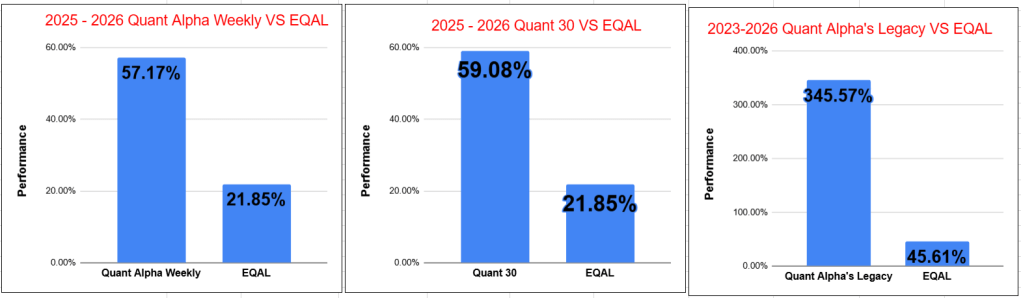
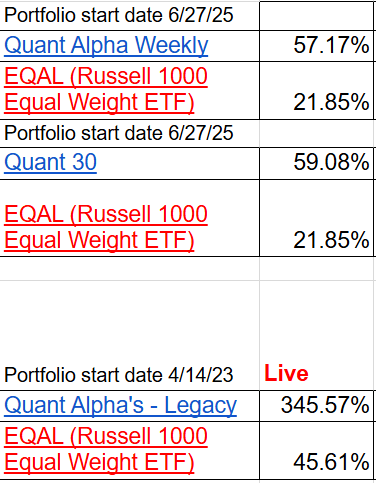
- Quant Weekly – Up over 57% since June 2025
- Quant 30 – Up over 59% since June 2025
- Legacy – Up over 340% since April 2023
- Education – Top 10 Bad Habits of Investors
USA Stock market week ending 07/31/26
- SPY (S&P 500 ETF): +1.1% – The broad U.S. market posted a solid weekly gain, continuing its upward trend.
- NASDAQ Composite (^IXIC): +1.6% – Technology and growth stocks led the major indexes higher for the week.
- DIA (Dow Jones Industrial Average ETF): +1.1% – Blue-chip stocks matched the S&P 500 with a steady weekly advance.
- IWM (Russell 2000 ETF): +0.0% – Small-cap stocks finished the week essentially unchanged, lagging the larger-cap indexes.
- SPMO (Invesco S&P 500 Momentum ETF): -1.8% – Momentum stocks underperformed the broader market, giving back ground despite gains in the major indexes.
Market Drivers this Week (08/03/26 – 08/07/26)
Monday, 8/3 — Manufacturing Data & Palantir
- Final July Manufacturing PMI, ISM Manufacturing Index, and June Construction Spending are released.
- Earnings include Marriott, Tyson Foods, Vertex Pharmaceuticals, ON Semiconductor, and Palantir Technologies after the close.
Tuesday, 8/4 — Jobs Data & AMD
- June Trade Balance, Factory Orders, and JOLTS Job Openings highlight the economic calendar.
- Earnings include Advanced Micro Devices (AMD), Booking Holdings, Prudential Financial, Wynn Resorts, and DaVita.
Wednesday, 8/5 — ISM Services & Major Earnings
- The ISM Services PMI provides an update on the U.S. services sector.
- Earnings include Caterpillar, McDonald’s, Merck, Walt Disney, Eli Lilly, Costco, and Kraft Heinz.
Thursday, 8/6 — Jobless Claims
- Weekly Initial Jobless Claims, productivity, and labor cost data are released.
- Earnings include Uber, Shopify, eBay, Western Digital, SanDisk, Novo Nordisk, and Manulife Financial.
Friday, 8/7 — July Employment Report
- The July Jobs Report takes center stage as the week’s most important economic release.
The CNN Fear and Greed Index ends the week at 42 in the Fear area. This makes eight weeks out of the last nine weeks in the Fear area. Risk off is firmly in control of the stock market right now.
The Quant Model Portfolios were lower last week following the general trend of the Momentum stocks which are still dropping. I hope investors took advantage of the lower prices on some of the best performing stocks in the the Model Portfolios, to add to current positions.

Note: You are reading the free subscriber newsletter. Paid subscribers enjoy instant access to weekly Model Portfolio updates upon release. Free subscribers get access to Portfolio updates after a three-week delay. Want timely access to the new Adds/Removes? Subscribe
No changes to the three main Model Portfolios for two weeks straight now. Upcoming earnings reports should start to see some changes in the Quant ratings and this should increase the turnover in the Quant 30 Portfolio.
Model Portfolio Quant Alpha Weekly
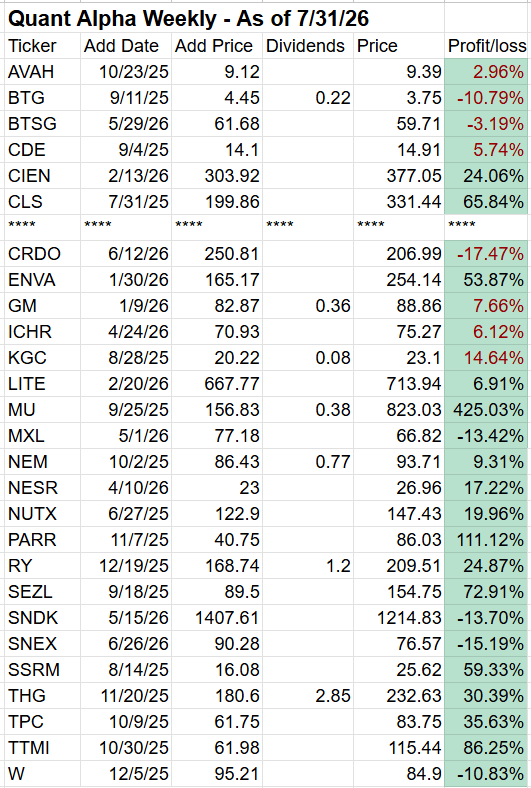
Any newly added stock is being released to Paid Subscribers today. Below are the updates from three weeks ago. This Portfolio continues to significantly outperform its benchmark, 57% versus 21%. It has 28 members.
Top five Quant stocks in the Portfolio (Paid subscribers only).
Add (07/10/26) : None
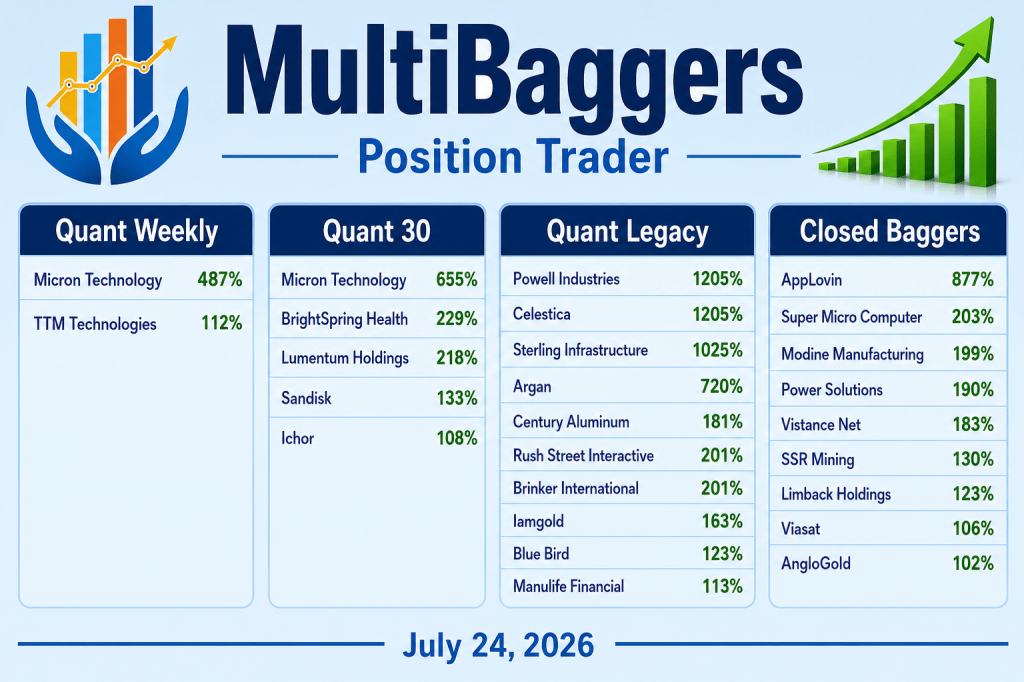
Outperformers: SEZL (Sezzle) up over +72%, MU (Micron Technology) up over +420%, TTMI (TTM Technologies) up over +80%, CLS (Celestica) up over +50%
Model Portfolio Quant 30
This week’s new update, if any, is being released to the paid subscribers. Shown below is the update made three weeks ago. This Portfolio continues to beat its benchmark by a wide margin, 59% to 21%. It has 30 members in it.
Top five Quant stocks in the Portfolio (Paid subscribers only).
Add (07/10/26): None
Remove (07/10/26): None
Outperformers: MU (Micron Technology) up over +570%, LITE (Lumentum Holdings) up over +190%, TTMI (TTM Technologies) up over +60%, BTSG (BrightSpring Health) up over +160% and SNDK (Sandisk) up over +90%
Model Portfolio Quant Alpha’s – Legacy
The portfolio is up over +340% since it began in 2023. It has 17 stocks in it. Powell industries is now a 10 bagger. Celestica is now a 13 bagger
Top five Quant stocks in the Portfolio (Paid subscribers only).
Remove (07/10/26): None
Outperformers: AGX (Argan) up over +700%, STRL (Sterling Infrastructure) up over +900%, POWL (Powell Industries) up over +1000% and CLS (Celestica) is up over +1300%
Model Portfolio Quant Top Stock
This new Portfolio adds one new stock a week. A separate email is sent on Thursday morning detailing the selection, a shallow dive on the pros and cons of the stock and the criteria used for the Portfolio.
Add: SEZL (Sezzle) – Transaction & Payment Processing Services

Performance to 07-31-2026
Top Quant Stocks for this week – (Paid subscribers only feature)
Paid subscribers were presented with a list of the Top 10 IT excluding semiconductors today.

Top 10 Bad Habits of Investors
Checking your portfolio obsessively.
Constant checking turns investing into an emotional rollercoaster and makes ordinary volatility feel urgent when it’s just noise. This trains your brain to associate investing with anxiety, making panic-selling far more likely. I try to avoid that by limiting the amount of times I check my portfolios in a week.
Chasing whatever has been hot recently.
Buying after a big run means entering after the easy gains are gone, often right as momentum fades. Recency bias — assuming recent performance will continue — has fueled every major bubble in market history.
Trading too frequently.
Excessive trading racks up costs, spreads, and taxes that quietly drag down returns. Studies consistently show the most active traders significantly underperform the least active ones. That is why I practice Position Trading. Buy/Sell for medium and long term.
Having no exit strategy.
Most investors plan what to buy but never plan when to sell, leaving decisions to emotion in the moment. This leads to holding winners too long or panic-selling temporary dips. I have written rules that guide when I will sell a stock. I keep to it at all times.
Letting fear and greed drive decisions.
Buying at euphoric tops and selling at panicked bottoms is the most reliable way to buy high and sell low. This emotional whipsaw is the natural human response to volatility — and it’s precisely backward.
Confusing a company you like with a good investment.
Buying stock just because you love the product skips the actual work of evaluating financial soundness and valuation. Familiarity bias also makes it psychologically hard to sell when fundamentals turn.
Refusing to admit mistakes.
Holding a loser indefinitely to avoid “locking in” a loss ignores that only current price and future prospects matter — not what you originally paid. Loss aversion keeps investors anchored to bad positions far too long. I see many investors end up with a portfolio of losers having kept the losers and selling the winners. Index funds are a better option in that case.
Trying to time the market.
Timing requires being right twice, consistently — nearly impossible even for professionals. Missing just the ten best trading days in a decade can cut long-term returns in half. I have learned over the years that the market moves up in sudden jumps. Especially when it bounces up from a sell-off.
Anchoring to arbitrary price points.
Refusing to sell until “it gets back to even,” or refusing to buy because “it’s already up so much,” both treat irrelevant past prices as meaningful. The market doesn’t care what you paid — only current value matters. I have learned the hard way that hanging on to losers because I don’t want to admit I screwed up, is self defeating and leads to underperformance.
Comparing your portfolio to others.
Benchmarking against a friend’s lucky win or an influencer’s highlight reel creates pressure to abandon a sound strategy for FOMO. You never see the risk, losses, or luck behind someone else’s results — only the parts they choose to share.

Quick Links
- Live Scorecard
- Model Portfolio Quant Alpha Weekly
- Click here for the Quant Alpha Weekly details
- Model Portfolio Quant 30
- Click here for the Quant 30 details
- Model Portfolio Quant Alpha’s – Legacy
- Click here for the Quant Alpha’s – Legacy details
- Position Trader educational blog posts
- Position Trader – blog post user guide
All content on this site is for informational purposes only and does not constitute financial advice. Consult relevant financial professionals in your country of residence to get personalized advice before you make any trading or investing decisions. This post was written with the assistance of artificial intelligence. The original ideas and final review are human-generated. Disclaimer
Copyright 2023-2026 SwingTrader.Trading. All Rights Reserved.


You must be logged in to post a comment.