
- What does the company do?
- Why Some Investors Are Bullish
- What Bears Are Worried About
- Why the Quants like this stock
- My View
What does the company do?
DHT Holdings, Inc., through its subsidiaries, owns and operates crude oil tankers primarily in Monaco, Singapore, Norway, and India. The company also offers technical management services. As of December 15, 2025, it had a fleet of 22 very large crude carriers. The company was incorporated in 2005 and is headquartered in Hamilton, Bermuda.
Why Some Investors Are Bullish
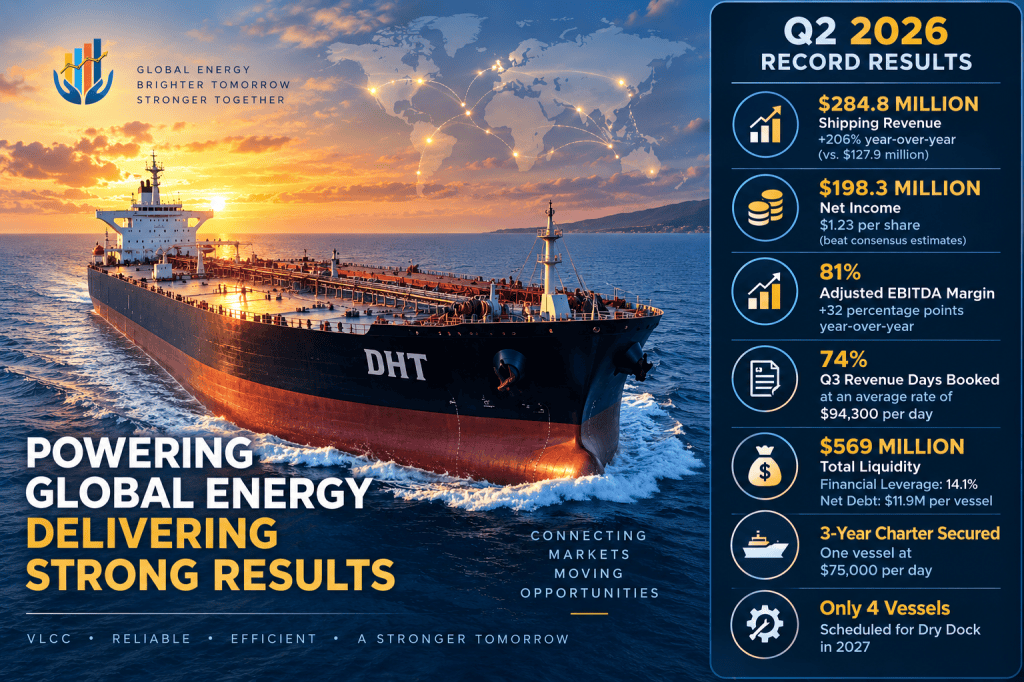
- Record profitability – DHT’s Q2 results were exceptional across the board. Adjusted EBITDA reached $231 million, while average fleet TCE was $126,700 per day, including $162,600 per day for spot-market VLCCs and $90,800 for time-chartered vessels. That translates into an adjusted EBITDA margin of roughly 81% based on shipping revenue, illustrating how powerful tanker pricing can be when rates surge.
- Strong balance sheet and liquidity – DHT entered the second half of the year with a relatively conservative balance sheet. At June 30, the company reported $161.7 million of cash and $407.5 million of available revolving credit capacity, for total liquidity of approximately $569 million. Financial leverage was 14.1% based on fleet market values, while net debt was only $11.9 million per vessel. That financial flexibility gives DHT room to fund vessels, reduce debt and return capital to shareholders.
- Strong near-term revenue visibility – DHT entered Q3 with 74% of available revenue days booked at an average rate of $94,300 per day. The company also had approximately 48% of available spot days booked at $139,700 per day and subsequently secured a three-year time charter for the DHT Jaguar at $75,000 per day. That provides investors with meaningful visibility into near-term revenue even though a significant portion of the fleet remains exposed to spot rates.
- Significant shareholder distributions – DHT continues to return a substantial portion of its earnings to shareholders. The company declared a $1.22-per-share dividend for Q2, compared with $0.64 in Q1 and $0.24 a year earlier. During the quarter, approximately $103 million was distributed through cash dividends, while DHT also prepaid $56 million of long-term debt. The company’s capital-allocation approach gives investors exposure to both current income and potential balance-sheet improvement.
- Favorable near-term maintenance schedule – DHT expects only four vessels to enter dry dock during 2027, providing a relatively light maintenance schedule. That could help maximize vessel availability if tanker rates remain favorable.
What Bears Are Worried About
- Tanker rates are highly cyclical – The biggest risk is that today’s extraordinary earnings may not be sustainable. DHT’s Q2 combined TCE of $126,700 per day was dramatically higher than the prior-year period, demonstrating just how sensitive earnings are to tanker-market conditions. If crude-oil trade flows normalize or tanker supply increases, rates could fall sharply and take earnings and dividends with them.
- Geopolitical conditions are boosting demand – Management said the strong market was supported by regional disruptions, particularly the conflict involving Iran, which expanded global ton-miles. DHT emphasized that its fleet did not trade in the Persian Gulf, prioritizing crew and vessel safety rather than pursuing higher-risk rates. If geopolitical tensions ease and shipping routes normalize, some of the current rate premium could disappear.
- The dividend is intentionally tied to current earnings – DHT’s $1.22 quarterly dividend is impressive, but investors should not treat it as a fixed annualized yield. The payout is closely connected to the company’s earnings and cash generation, meaning future dividends can fall substantially if tanker rates decline. For an income investor, this is an important distinction: DHT offers potentially high income, but not necessarily predictable income.
Why the Quants like this stock
P/E Non-GAAP (FWD) A 6.04
PEG GAAP (TTM) A- 0.05
Revenue Growth (YoY) A 43.22%
ROE Growth (YoY) A- 119.78%
Return on Common Equity (TTM) A+ 39.18%
3M Price Performance A+ 32.13%
FY1 Up Revisions (last 90 days) 5 up and 0 down
Div Yield (FWD) 22.18%
Latest Quarter’s Earnings
Announce Date 8/5/2026
EPS GAAP Actual $1.23 (Beat by $0.01)
EPS Normalized Actual $1.22 (Beat by $0.08)
Revenue Actual $255.16M
Revenue Surprise Beat by $16.81M
My View
DHT’s second-quarter numbers are difficult to ignore: record quarterly earnings, first-half profits above its previous full-year record, strong liquidity, low leverage and substantial shareholder distributions.
But this is still a cyclical tanker company, not a predictable compounder. The investment thesis depends heavily on VLCC rates, global oil flows, vessel supply and geopolitical conditions.
For investors, the key question isn’t whether DHT’s Q2 results were exceptional—they clearly were. The bigger question is how much of today’s extraordinary tanker economics can persist after the current market disruption eventually fades.
All content on this site is for informational purposes only and does not constitute financial advice. Consult relevant financial professionals in your country of residence to get personalized advice before you make any trading or investing decisions. This post was written with the assistance of artificial intelligence. The original ideas and final review are human-generated. Disclaimer
Copyright 2023-2026 SwingTrader.Trading. All Rights Reserved.
 Position Trader