

- Selection for this week
- Some Pros about the stock
- Some Cons about the stock
- Why the Quants like this stock
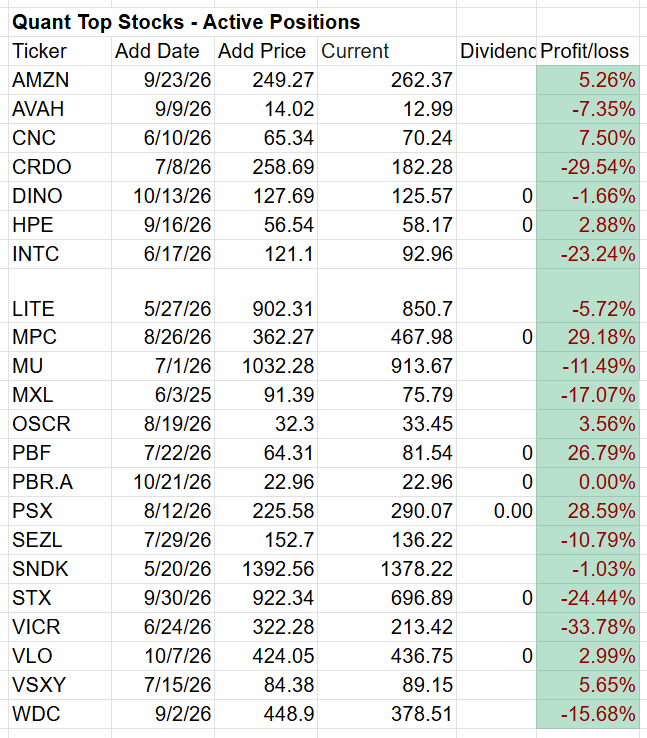
- Active Positions
- Quick Links
The momentum stocks in the portfolio as a group are lower when compared to last Thursday. Risk off continues to have a grip on the US stock market. Patience is needed here.
Add: PBR.A (Petrobras)
What does the company do?
Petróleo Brasileiro S.A. (Petrobras) is a Brazil-based integrated energy company founded in 1953 and headquartered in Rio de Janeiro. Its operations span three segments: Exploration and Production, Refining, Transportation & Marketing, and Gas & Low Carbon Energies. The company explores for and produces oil and natural gas, refines and markets petroleum products, operates energy transportation and logistics networks, generates electricity, and invests in renewable and lower-carbon energy businesses.
Why Some Investors Are Bullish
- Strong Q2 financial results. Petrobras reported $33.61 billion in sales revenue and $10.43 billion in net income attributable to shareholders. Adjusted EBITDA reached $18.62 billion, more than double the year-ago quarter, reflecting stronger operating performance and higher oil prices.
- Record production and refinery utilization. Company-operated oil production in Brazil reached 2.7 million barrels per day, up 15% year over year. Refinery utilization hit 101%, while petroleum-product output reached 1.9 million barrels per day, supporting domestic supply and reducing imports.
- Robust cash generation. Operating cash flow reached $12.25 billion, up approximately 46% from Q1, while free cash flow rose to $7.66 billion from $3.86 billion. Excluding one-off events, adjusted EBITDA was approximately $19.96 billion, highlighting the strength of the underlying quarter.
- An inexpensive earnings multiple. PBR.A traded at a trailing price-to-earnings ratio of roughly 5.7 in recent market-data snapshots. That valuation may appeal to value investors, although earnings multiples for oil producers can be misleading when commodity prices and profits fluctuate significantly.
- A defined shareholder-remuneration policy. Petrobras approved R$17.4 billion in dividends and interest on equity related to the first half of 2026. Its policy generally calls for distributing 45% of free cash flow when gross debt meets the applicable threshold and other conditions are satisfied, providing investors with a framework for future payouts.
What Bears Are Worried About
- Political and export-tax risk. Brazil’s government remains Petrobras’ controlling shareholder, creating potential conflicts between commercial objectives and public-policy priorities. A temporary crude-oil export tax of 12% resulted in approximately $1.09 billion of expense in the first half of 2026. The levy was extended for another 60 days beginning in September, adding uncertainty to export economics.
- Dividends are variable, not guaranteed. Shareholder distributions depend on free cash flow, oil prices, investment requirements, and debt conditions. Management indicated that extraordinary dividends were unlikely under its then-current outlook for Brent crude. Investors should not assume recent payouts will continue at the same level.
- Significant debt and a sharply higher share price. Gross debt stood at $70.8 billion and net debt at $60.4 billion at June 30. Although gross debt remained below the company’s $75 billion ceiling, Petrobras continues to target a reduction toward $65 billion. PBR.A has also risen substantially from its 52-week low, and one recent analyst compilation put its average target below the October 21 closing price. These factors leave room for disappointment if oil prices weaken or earnings normalize.
Why the Quants like this stock
P/E Non-GAAP (FWD) A+ 4.39
ROE Growth (YoY) B 51.30%
Return on Common Equity (TTM) A 30.31%
3M Price Performance A+ 39.57%
FY1 Up Revisions (last 90 days) 5 Up and 0 Down
Latest Quarter’s Earnings
Announce Date 8/6/2026
EPS GAAP Actual $1.62 (Beat by $0.23)
Revenue Actual $33.57B
Revenue Surprise Beat by $2.40B
My View
Petrobras combines strong production, substantial cash generation, a relatively low earnings multiple, and the potential for meaningful shareholder distributions. The main risks are government influence, export taxation, commodity-price volatility, and the variability of dividends. Following the stock’s strong advance, investors should compare the preferred ADR’s current price with realistic earnings and payout assumptions rather than relying solely on past returns or headline dividend yields.

Active Positions
Quick Links
- Live Scorecard
- Model Portfolio Quant Alpha’s II
- Click here for the Quant Alpha’s II details
- Model Portfolio Quant 30
- Click here for the Quant 30 details
- Model Portfolio Quant Dividend and Growth 25
- Model Portfolio Quant Top Stocks
- Click here for the Quant Top Stocks details
- Model Portfolio Quant Alpha’s – Legacy
- Click here for the Quant Alpha’s – Legacy details
- Position Trader educational blog posts
- Position Trader – blog post user guide
All content on this site is for informational purposes only and does not constitute financial advice. Consult relevant financial professionals in your country of residence to get personalized advice before you make any trading or investing decisions. This post was written with the assistance of artificial intelligence. The original ideas and final review are human-generated. Disclaimer
Copyright 2023-2026 SwingTrader.Trading. All Rights Reserved.

