
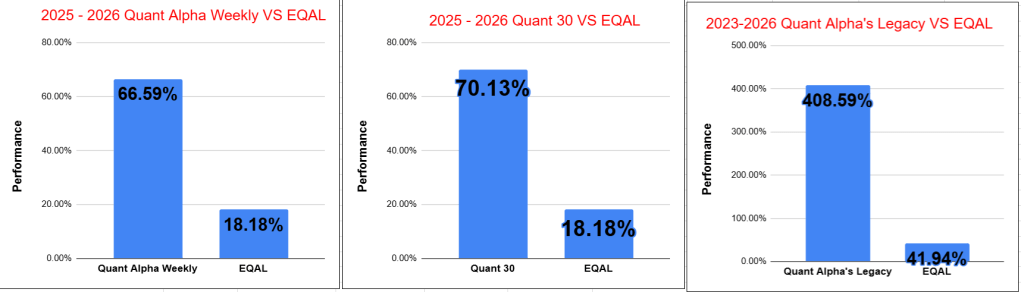
- Quant Weekly – Up over 66% since June 2025
- Quant 30 – Up over 70% since June 2025
- Legacy – Up over 400% since April 2023
- Sterling Infrastructure (STRL) became a 13 bagger in the Legacy Portfolio this week
- Education – Is sell in May and go away a viable investment strategy?
- Quick Links – At the bottom of the Post
USA Stock market week ending 05/08/26
Major Index Performance (Weekly)
- SPY (S&P 500 ETF) +2.4%
- Large-cap U.S. stocks posted a strong weekly advance as investor sentiment improved and broader market participation expanded.
- ^IXIC (Nasdaq Composite) +4.5%
- Technology and growth stocks led the market sharply higher, giving the Nasdaq the strongest performance among the major indexes.
- DIA (Dow Jones Industrial Average ETF) +0.2%
- Blue-chip industrial and defensive names lagged the broader market, producing only modest gains for the week.
- IWM (Russell 2000 ETF) +1.8%
- Small-cap stocks moved higher as risk appetite improved, though performance still trailed the technology-heavy Nasdaq.
Takeaways
- Technology and growth stocks clearly dominated market performance during the week.
- The Nasdaq significantly outperformed the Dow, highlighting continued investor preference for higher-growth sectors.Broader market participation improved, with both large-cap and small-cap indexes finishing the week higher.
Market Drivers this Week (05/11/26 – 05/15/26)
Monday
- U.S.-China trade talks could move tech, retail, and industrial stocks hard depending on tariff headlines.
- New Fed Chair Kevin Warsh starts his first full week, and traders are watching for any shift in Fed tone.
Tuesday
- CPI inflation data drops and could completely change rate-cut expectations.
- Walmart earnings give a major read on consumer spending strength and retail demand.
Wednesday
- PPI inflation data could fuel more stagflation worries if wholesale prices stay hot.
- Cisco earnings are a key test for AI infrastructure and enterprise tech spending.
Thursday
- Retail sales numbers show whether the American consumer is still spending aggressively.
- Applied Materials earnings could swing the semiconductor and AI chip trade.
Friday
- Consumer sentiment and inflation expectations could move both stocks and bonds heading into the weekend.
- Options expiration and U.S.-China trade deal details could add extra volatility late in the week.
The CNN Fear and Greed Index ends the week at Greed 67. This is the fourth week in row at the Greed setting. This follows nine straight weeks at the Fear or Extreme Fear setting. Risk-on is certainly in the drivers seat and the market reflects this.
The Quant 30, Quant Weekly and Quant Legacy Model Portfolios all made all time highs this week. Quant Weekly and Quant 30 have been higher for seven weeks in a row. Risk On is fully in control and we continue to ride the wave up.

Note: You are enjoying the free subscriber newsletter. Paid subscribers enjoy instant access to weekly Model Portfolio updates upon release and a Top Quant Stocks list. Free subscribers get access to Portfolio updates after a three-week delay but no Top Quant Stocks list. Want timely access to the new Adds/Removes and Top Quant Stocks list? Subscribe
Model Portfolio Quant Alpha Weekly
Any newly added stock is being released to Paid Subscribers today. Below are the updates from three weeks ago. This Portfolio continues to significantly outperform its benchmark, 66% versus 18%. It has 25 members.
Top five Quant stocks in the Portfolio (Paid subscribers only).
No changes to the Portfolio this week
Add (04/17/26) : None
Remove (04/17/26) : None
Outperformers: SSRM (SSR Mining) up over 110%, MU (Micron Technology) up over 370%, VISN (Vistance Networks) up over +170%

Model Portfolio Quant 30
This week’s new update, if any, is being released to the paid subscribers. Shown below is the update made three weeks ago. This Portfolio continues to beat its benchmark by a wide margin, 70% to 18%. It has 30 members in it.
Top five Quant stocks in the Portfolio (Paid subscribers only).
No changes to the Portfolio this week
Add (04/17/26): None
Remove (04/17/26): None
Outperformers: MU (Micron Technology) up over 510%, GFI (Gold Fields) up over 80%, LITE (Lumentum Holdings) up over 270% and TTMI (TTM Technologies) up over 120%
Model Portfolio Quant Alpha’s – Legacy
The portfolio is up over +400% since it began in 2023. It has 18 stocks in it. Powell industries is now a 16 bagger. Celestica is now a 15 bagger and now Sterling Infrastructure has become a 13 bagger.
Sterling Infrastructure had blow out earnings this past week. It started the week at $532 and ended the week at $844. It is now a 13 bagger.
Top five Quant stocks in the Portfolio (Paid subscribers only).
Remove (04/17/26): None
Outperformers: AGX (Argan) up over 800%, STRL (Sterling Infrastructure) up over 1300%, POWL (Powell Industries) up over 1600% and CLS (Celestica) is up over 1500%

Performance to 05-08-2026

Top Quant Stocks for this week – (Paid subscribers only feature)

Is sell in May and go away a viable investment strategy?
WHERE THE PHRASE COMES FROM
- Old-school Wall Street saying — not some modern quant model
- Came from London traders who literally left for summer vacation
- Idea: Stocks underperform May → October vs November → April
WHAT THE DATA ACTUALLY SHOWS (HISTORICALLY)
- Winter months have been stronger — no argument there
- Nov–Apr avg return ~6–8% vs ~2–3% May–Oct
- Markets are still positive in the summer — just weaker on average
- May–Oct positive ~2/3 of the time
- Long-term studies confirm the “gap” exists
- Returns ~4% higher in winter vs summer periods
In other words – Yeah, there’s a seasonal pattern — but it’s not a crash season, just a slower one
BUT HERE’S THE PROBLEM — IT DOESN’T HOLD UP CONSISTENTLY
- Staying invested actually wins long-term
- Buy & hold CAGR ~8.05% vs ~6.86% using Sell-in-May strategy
- You miss compounding by sitting out
- Small differences each year → massive gap over decades
- Recent decades? Way less reliable
- Markets have gone up in most May–Oct periods (25 of last 33 years)
- Some studies say it only worked ~14 out of 38 years
- That’s basically a coin flip
It worked “kind of” in the past… but not enough to bet your portfolio on it
MODERN MARKET REALITY (THIS IS WHY IT’S FADING)
- Markets don’t shut down anymore
- Algorithms, global trading, 24/7 flows
- AI, macro, geopolitics > seasonality now
- Big drivers matter more than the calendar
- Summer can still rip
- Plenty of strong rallies happen May–August
The calendar isn’t moving markets — money flows are
WHEN IT CAN STILL HAVE VALUE
- Short-term traders use it as a bias, not a rule
- Helps frame expectations for weaker seasonality
- Late summer (Aug–Oct) tends to be the weakest stretch
- That’s where most volatility historically shows up
- Works better in certain cycles (like election years)
- Not consistent, but sometimes shows up
BOTTOM LINE
- “Sell in May” isn’t a strategy — it’s a tendency
- Yes, returns are weaker in summer… but still positive most of the time
- If you follow it blindly, you’re probably leaving money on the table
- Smart investors don’t sell because of the calendar —
they sell because the setup changes

“SELL IN MAY” — WHEN IT ACTUALLY WORKS (AND WHEN IT BLOWS UP)
WHEN IT WORKS (EDGE CASES)
- Late-cycle or overextended markets
- When valuations are stretched and momentum is fading
- Think: market already ran hard → summer = digestion or pullback
- Rising interest rates / tightening liquidity
- When the Fed is tightening, summer weakness shows up more
- Liquidity dries up → fewer buyers → softer markets
- Pre-recession or macro uncertainty
- When economic data starts rolling over
- Summer becomes risk-off before the real damage hits
- Weak leadership / narrow market breadth
- If only a few stocks are carrying the market, it’s fragile
- Summer rotations can hit those leaders hard
- Post big Q1 rallies
- If Jan–April was strong, May–Sept often cools off
- Markets need to reset before next leg
- August–October window (THIS is the real danger zone)
- Most historical volatility lives here — not May/June
- That’s where corrections usually show up
WHEN IT FAILS (AND COSTS YOU MONEY)
- Early bull markets / fresh breakouts
- When a new uptrend just started — you do NOT want to leave
- That’s when big upside happens
- Strong earnings + strong macro combo
- If companies are beating and economy is stable → market grinds higher
- No reason for seasonal weakness to kick in
- AI / structural themes driving flows
- When there’s a dominant narrative (like AI)
- Money doesn’t care about the calendar — it chases growth
- Heavy institutional inflows
- If big money is rotating in, seasonality gets ignored
- Flows > historical averages
- Election years / stimulus cycles
- Markets often stay supported longer than expected
- Low volatility environments
- If VIX is low and stable → dips get bought quickly
BOTTOM LINE
- “Sell in May” isn’t wrong — it’s just incomplete
- The real edge is knowing when the environment matches the pattern
- If you treat it like a rule, you lose

Quick Links
- Live Scorecard
- Model Portfolio Quant Alpha Weekly
- Click here for the Quant Alpha Weekly details
- Model Portfolio Quant 30
- Click here for the Quant 30 details
- Model Portfolio Quant Alpha’s – Legacy
- Click here for the Quant Alpha’s – Legacy details
- Position Trader educational blog posts
- Position Trader – blog post user guide
All content on this site is for informational purposes only and does not constitute financial advice. Consult relevant financial professionals in your country of residence to get personalized advice before you make any trading or investing decisions. This post was written with the assistance of artificial intelligence. The original ideas and final review are human-generated. Disclaimer
Copyright 2023-2026 SwingTrader.Trading. All Rights Reserved.


You must be logged in to post a comment.